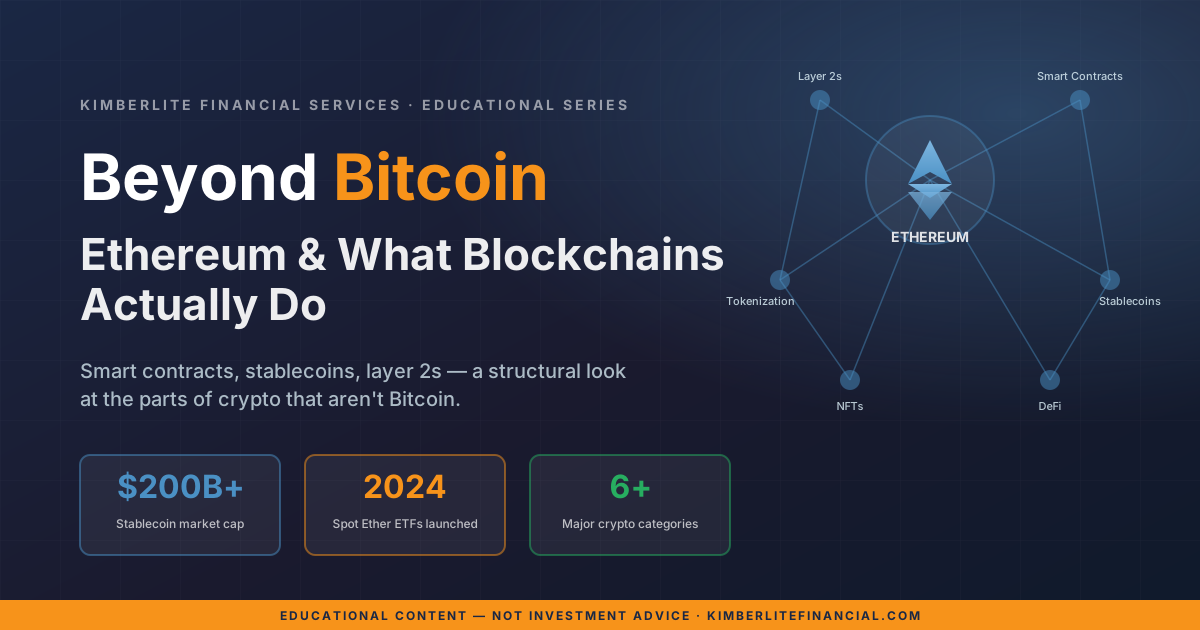
A plain-English look at smart contracts, stablecoins, and the parts of crypto that aren't Bitcoin.
Bitcoin gets the headlines. The rest of crypto is where most of the activity is actually happening.
Ethereum settles trillions of dollars in transactions per year. Stablecoins move comparable annual volumes to Visa across networks. Real-world assets are being tokenized by BlackRock and others. None of that is Bitcoin.
This post is an educational walk-through of what's happening on blockchains beyond Bitcoin — what the categories actually are, what they do, and how the research and institutional views frame them. It is not investment advice and not a recommendation to buy any specific asset. The goal is structural understanding, so the headlines start to make more sense.
Bitcoin and Ethereum are both blockchains, but they are solving different problems.
Bitcoin is designed to be one thing: digital money with a fixed supply (capped at 21 million coins) that's resistant to censorship and inflation. It does this very well, and almost nothing else.
Ethereum is designed to be a programmable platform — a kind of decentralized computer where applications can run without a central operator. The base currency, Ether (ETH), is what users pay to use the network. The network itself is the product.
A "smart contract" sounds technical, but the concept is straightforward. It's a program that runs automatically when conditions are met.
Real-world example: imagine a simple lending agreement. Normally that requires a bank, a contract, a signature, a way to verify income, and a way to enforce repayment. A smart contract can replace much of that with code: "If borrower deposits $X of collateral, send them $Y of stablecoin. If the value of the collateral falls below a threshold, automatically liquidate it to repay the loan."
The same logic applies to insurance payouts (if a flight is delayed by 4+ hours, send $200), trading (swap one asset for another at the current price), and many other financial primitives.
The advantage is automation and 24/7 availability. The risk is that bugs in the code or in the system design can be exploited — and unlike a bank, there is no fraud department to call. That is a real risk and a real reason to size positions carefully.
The "altcoin" world is more organized than the noise suggests. Most projects fall into one of several categories.
Ethereum is by far the largest. Others include Solana (high throughput), Avalanche, and a handful more. They compete on speed, cost, and security tradeoffs. Each has its own ecosystem of applications running on top.
Tokens designed to maintain a 1:1 peg to the U.S. dollar. USDC (Circle) and USDT (Tether) dominate. Increasingly used for international remittances, B2B payments, and as the "cash" inside crypto trading.
Built on top of Ethereum to make it cheaper and faster. Examples: Arbitrum, Optimism, Base (operated by Coinbase). Process transactions off-chain and settle results back to Ethereum.
Apps recreating traditional financial services using smart contracts — Aave (lending), Uniswap (trading), MakerDAO (collateralized stablecoins). Real users, real volume, real risks.
Using blockchain rails to represent ownership of off-chain assets — Treasuries, real estate, money market funds. BlackRock's BUIDL fund (2024) is a tokenized money market fund on Ethereum.
A way to represent unique items on a blockchain. The 2021 art hype has cooled. The underlying concept (verifiable digital ownership) is being applied to ticketing, gaming, identity, and real estate titling.
The history of crypto is full of projects that promised revolution and delivered nothing. Distinguishing the two is the hard part. A few useful filters from institutional research and practitioner experience:
A few neutral observations from the available research:
First, exposure to crypto outside Bitcoin is now possible inside regulated investment vehicles. Spot Ether ETFs (BlackRock's ETHA, Grayscale's ETHE, Fidelity's FETH, and others) launched in 2024. These trade like any other ETF and can be held in retirement accounts.
Second, the major asset managers' research treats Bitcoin and Ethereum as the two largest crypto allocations to consider, with most other categories framed as more speculative. Allocation recommendations for "crypto" overall typically still fall in the 1%–5% range that emerged from Bitcoin-specific research.
Third, the technology itself has uses that go beyond investment. Stablecoins for international remittances, tokenized Treasuries for institutional yield, smart contracts for automated escrow — these are infrastructure plays that don't require holding speculative tokens.
Fourth, the risks are real. Volatility is high. Some projects fail. Some are fraudulent. Bridges between blockchains have been attacked for hundreds of millions of dollars. None of this is a reason to dismiss the category — but it is a reason to size positions thoughtfully and to understand what you actually own.
Kimberlite Financial Services offers educational consultations covering both traditional portfolios and digital assets. Informational, not a sales pitch.
Schedule a free intro call → · Our approach to digital assets
Educational Content Only. This content is provided by Kimberlite Financial Services for educational and informational purposes only. It is not personalized investment, tax, legal, or insurance advice and should not be relied upon as such. The information presented reflects publicly available research, regulatory developments, and general principles as of the date of publication, and may become outdated.
Investment products carry risk, including the potential loss of principal. Past performance does not guarantee future results. Tax outcomes, insurance coverage, and the suitability of any strategy vary based on individual circumstances. References to specific firms, products, or research are illustrative and do not constitute endorsements or recommendations.
Before making any financial, investment, tax, insurance, or estate-planning decision, consult with a qualified professional who can evaluate your specific situation. Kimberlite Financial Services makes no representations or warranties regarding the completeness or accuracy of the information presented.