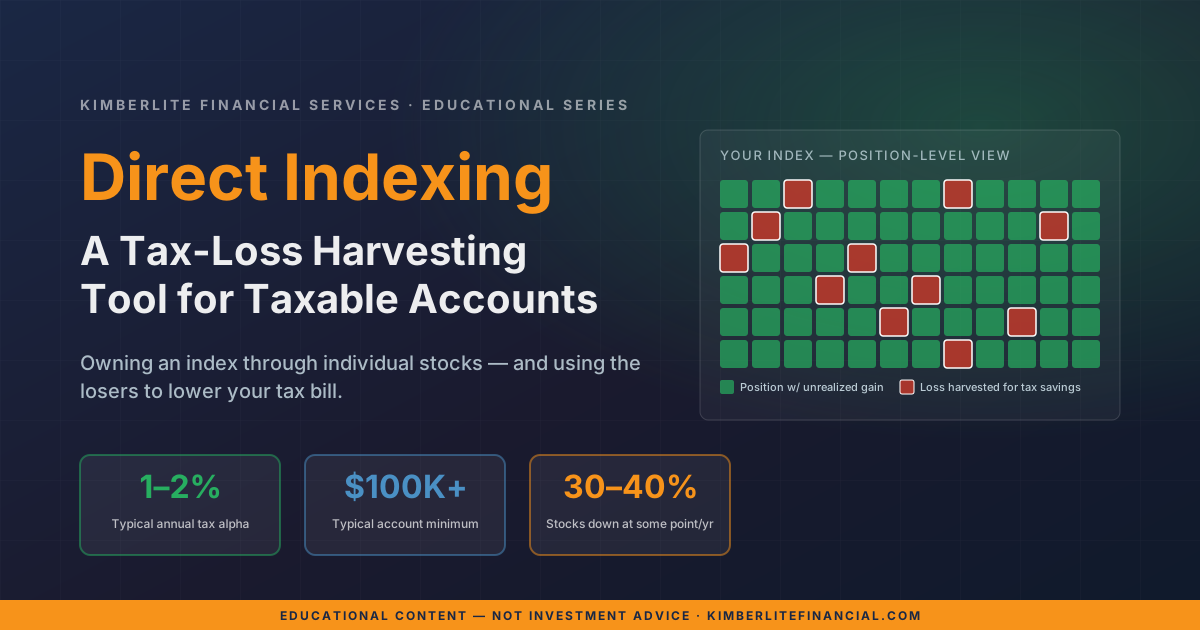
How owning an index through individual stocks — instead of a single fund — can produce meaningfully better after-tax returns for the right households.
Most investors who own "the S&P 500" actually own a single fund — VOO, SPY, or something similar. It's simple, low-cost, and works.
But for taxable accounts above a certain size, there's a different way to own the same exposure that can produce meaningfully better after-tax returns: direct indexing.
This post is an educational walk-through of how it works, where the tax savings actually come from, what kind of accounts it's appropriate for, and the tradeoffs involved. None of it is a recommendation. The right answer depends on tax bracket, account size, time horizon, and what other gain-realization events are happening in a household's financial life.
Prefer to watch? The 4½-minute animated version of this post.
Direct indexing means owning the individual stocks that make up an index, in roughly the same proportions, instead of owning a fund that holds them for you.
If you own VOO, you own a single fund that holds about 500 stocks. If you direct-index the S&P 500, your account holds roughly 200–500 individual stock positions, weighted to track the same index.
In any given year, even when an index goes up overall, some individual stocks inside it go down. Across a 500-stock index, 30% to 40% of the holdings typically show a loss at some point during the year — even in strong markets.
In a fund (VOO), you can't access those individual losses. The fund manages itself, and your only "lot" is your purchase of the fund as a whole.
In a direct-indexed account, you can sell the individual losing positions, harvest the loss for tax purposes, and immediately buy a similar (but not "substantially identical") stock to maintain the index exposure. The losses generated can be used in three ways:
The mechanics are usually automated by software. A direct-indexing platform monitors the portfolio daily and harvests losses as they appear, while staying within the bounds of IRS wash-sale rules.
Consider a hypothetical $1,000,000 taxable account direct-indexed against the S&P 500, in a year when the index rises 10%.
During the year, individual positions hit losses at various points. The platform harvests them automatically.
Of losses harvested across various lots while the index is rising.
If the same investor realizes $30,000 of gains elsewhere (e.g., sells a rental property), the harvested losses can offset that entire gain. At a 23.8% combined federal long-term capital gains + Net Investment Income Tax rate:
In tax — generated by a portfolio that otherwise just tracked the index.
Direct indexing is not a universal upgrade over ETFs. The math depends on several factors.
In practice the households this fits are the ones already dealing with concentrated stock and vesting schedules — which along the Wasatch Front usually means tech and finance employees. If that is you, my pages for a fee-based financial advisor in Salt Lake City and for Utah County equity-compensation planning go deeper on how the RSU and ESPP side interacts with this.
ETFs are not bad. They're an excellent default. Direct indexing isn't an upgrade — it's a different tool with different tradeoffs.
| Feature | ETF (e.g., VOO) | Direct Indexing |
|---|---|---|
| Cost (annual) | ~0.03% expense ratio | 0.20% – 0.45% management fee |
| Minimum | As little as $1 | Typically $100K – $250K |
| Tax-loss harvesting | Limited to fund-level events | Continuous, position-level |
| Customization | None | Full — exclusions, tilts, integrations |
| Complexity | Minimal — one position | Hundreds of lots; more complex tax reporting |
| Best for | Default index exposure, all account types | Larger taxable accounts in higher brackets |
It's not a way to beat the index. Direct indexing is designed to track an index — not outperform it on a pre-tax basis. The benefit is on the after-tax side.
Wash-sale rules apply. If you sell a stock at a loss and buy the same (or substantially identical) stock within 30 days, the IRS disallows the loss. Good direct-indexing platforms manage this automatically by buying similar but not identical replacement positions.
Losses are deferral, not elimination. When you harvest a loss, you reduce your cost basis. That means a larger gain when you eventually sell. The benefit is the time value of money — paying tax later is worth more than paying it now — and the option to never realize the gain (donate appreciated stock, step up basis at death).
Coordination with other accounts matters. Selling a stock at a loss in your taxable account and buying it back in your IRA can disallow the loss under wash-sale rules. Direct-indexing platforms manage this within the taxable account but can't see your other accounts. Coordination is part of the planning piece.
Direct indexing is one tool inside a larger tax strategy. Even when it's the right tool, the implementation details matter:
For investors with $250,000+ in taxable accounts and a complete tax picture that includes other gain-realization events, the analysis is usually worth running.
Kimberlite Financial Services offers educational consultations covering tax-efficient strategies — direct indexing, asset location, Roth conversions, charitable giving — as part of a full plan review.
Educational Content Only. This content is provided by Kimberlite Financial Services for educational and informational purposes only. It is not personalized investment, tax, legal, or insurance advice and should not be relied upon as such. The information presented reflects publicly available research, regulatory developments, and general principles as of the date of publication, and may become outdated.
Investment products carry risk, including the potential loss of principal. Past performance does not guarantee future results. Tax outcomes, insurance coverage, and the suitability of any strategy vary based on individual circumstances. References to specific firms, products, or research are illustrative and do not constitute endorsements or recommendations.
Before making any financial, investment, tax, insurance, or estate-planning decision, consult with a qualified professional who can evaluate your specific situation. Kimberlite Financial Services makes no representations or warranties regarding the completeness or accuracy of the information presented.