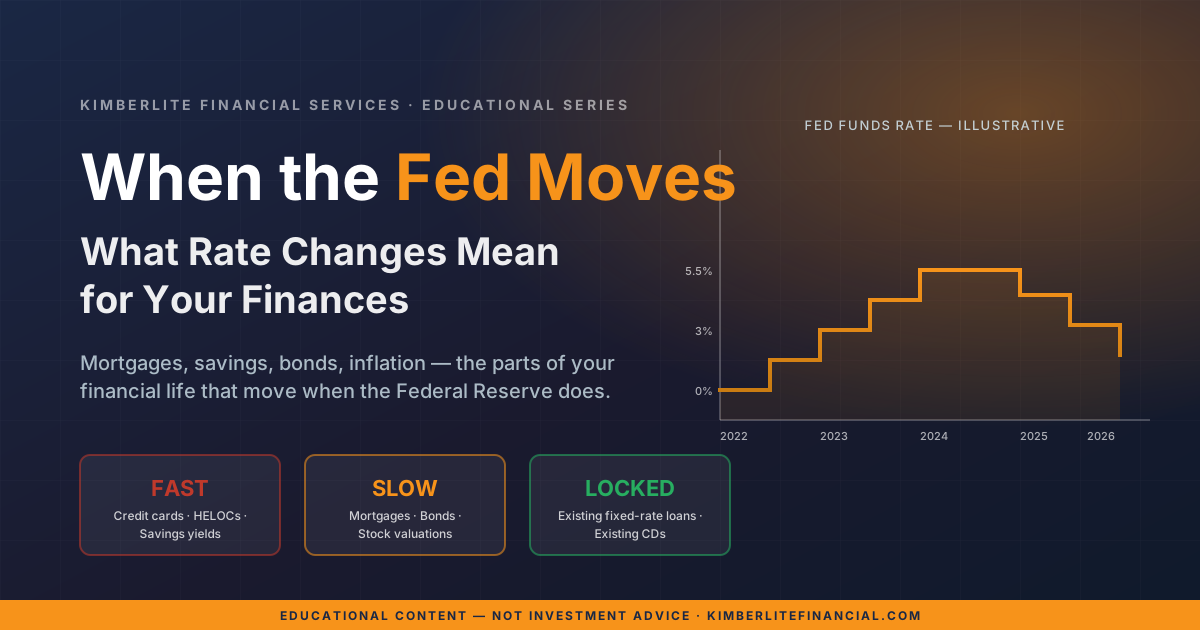
Mortgages, savings, bonds, inflation — the parts of your financial life that move when the Federal Reserve does.
The Fed moves rates, the news goes wild, and most people are left wondering whether they should do something — or what, exactly.
The honest answer is that most Fed decisions affect ordinary households more slowly and more indirectly than the headlines suggest. But they do affect them.
This post is an educational walk-through of what actually changes when the Fed raises or lowers rates, and where in your financial life those changes show up. Not advice. Not a market call. Just a map.
When you hear "the Fed cut rates" or "the Fed hiked," what's changing is the federal funds rate — the overnight rate banks charge each other to borrow.
The Fed doesn't directly set mortgage rates, savings rates, or any rate you personally encounter. What it does is set the wholesale cost of money for banks, and that cost ripples outward into every other rate in the economy.
Credit cards and HELOCs. Most have variable APRs tied directly to the prime rate, which moves in lockstep with the federal funds rate. A 0.25% Fed cut typically translates to a 0.25% credit card APR cut within one to two billing cycles. If you carry credit-card balances, Fed moves directly affect your monthly interest cost.
Money market and savings yields. These move within days to weeks. When the Fed cuts, savings yields drop. When the Fed hikes, they rise — though banks typically pass cuts through faster than they pass hikes through to depositors.
Short-term Treasuries. 1-month, 3-month, and 6-month Treasury yields track the Fed closely. If you hold T-bills or a short-term Treasury fund, your yield will reflect the Fed's path.
30-year mortgage rates. This is the one most people care about, and it doesn't move with the Fed funds rate directly. Mortgage rates track the 10-year Treasury yield, which is influenced by long-term inflation expectations, growth expectations, and demand for safe assets — only loosely connected to short-term Fed moves.
In practice: when the Fed cuts in response to weakening economic data, 30-year mortgage rates often move first (in anticipation) and may not move much further on the actual announcement. When the Fed hikes into a strong economy, mortgage rates may move only modestly.
Bond prices. When rates rise, existing bond prices fall (and vice versa), but the magnitude depends on the bond's duration. A 30-year Treasury can fall 15%–20% in price on a 1% rate hike; a 2-year Treasury falls maybe 2%.
Stock valuations. Lower rates support higher stock multiples (because the discount rate on future cash flows falls), but the relationship is loose and depends heavily on what's driving the rate change. Stocks can fall during cuts (if cuts are happening because the economy is weakening) and can rise during hikes (if hikes are happening because growth is strong).
The Fed's mandate is to manage inflation and employment. When inflation is high, the Fed raises rates to slow economic activity. When inflation is low and unemployment is rising, the Fed cuts to stimulate.
What matters most for households is real returns — what your money earns after accounting for inflation.
The 7% historical real return on equities is what actually compounded the wealth. Inflation is the silent variable that determines whether a yield is doing anything for you.
A few concrete observations about where Fed and inflation changes show up in a household budget and portfolio.
When 30-year mortgage rates fall meaningfully below your current rate, refinancing math gets interesting. Common rule of thumb: drop of 0.75%–1% + 5+ years remaining typically works once closing costs are factored.
When short-term yields are above 4%–5%, cash and money-market funds become real investments. When yields drop to 1%–2%, the opportunity cost of holding cash rises sharply.
In falling-rate environments, longer-duration bonds appreciate more. In rising-rate environments, they suffer more. Match duration to your time horizon — not to a Fed forecast.
A 30-year fixed at a low rate is one of the most valuable financial products available. Whether to pay it down early depends on what you can earn elsewhere — including in cash equivalents during high-rate periods.
TIPS and I Bonds adjust principal/yield based on inflation. Tend to underperform during low-inflation periods and outperform during high-inflation periods. A tool, not a default position.
Variable-rate balances move quickly with Fed cuts and hikes. Paying down a 22% credit card APR reliably outperforms most investment expectations regardless of where the Fed is headed.
A few common reactions that the research consistently identifies as counterproductive.
Kimberlite Financial Services offers educational consultations covering refinancing math, cash positioning, bond allocation, and inflation-protected assets in the context of a complete plan.
Educational Content Only. This content is provided by Kimberlite Financial Services for educational and informational purposes only. It is not personalized investment, tax, legal, or insurance advice and should not be relied upon as such. The information presented reflects publicly available research, regulatory developments, and general principles as of the date of publication, and may become outdated.
Investment products carry risk, including the potential loss of principal. Past performance does not guarantee future results. Tax outcomes, insurance coverage, and the suitability of any strategy vary based on individual circumstances. References to specific firms, products, or research are illustrative and do not constitute endorsements or recommendations.
Before making any financial, investment, tax, insurance, or estate-planning decision, consult with a qualified professional who can evaluate your specific situation. Kimberlite Financial Services makes no representations or warranties regarding the completeness or accuracy of the information presented.