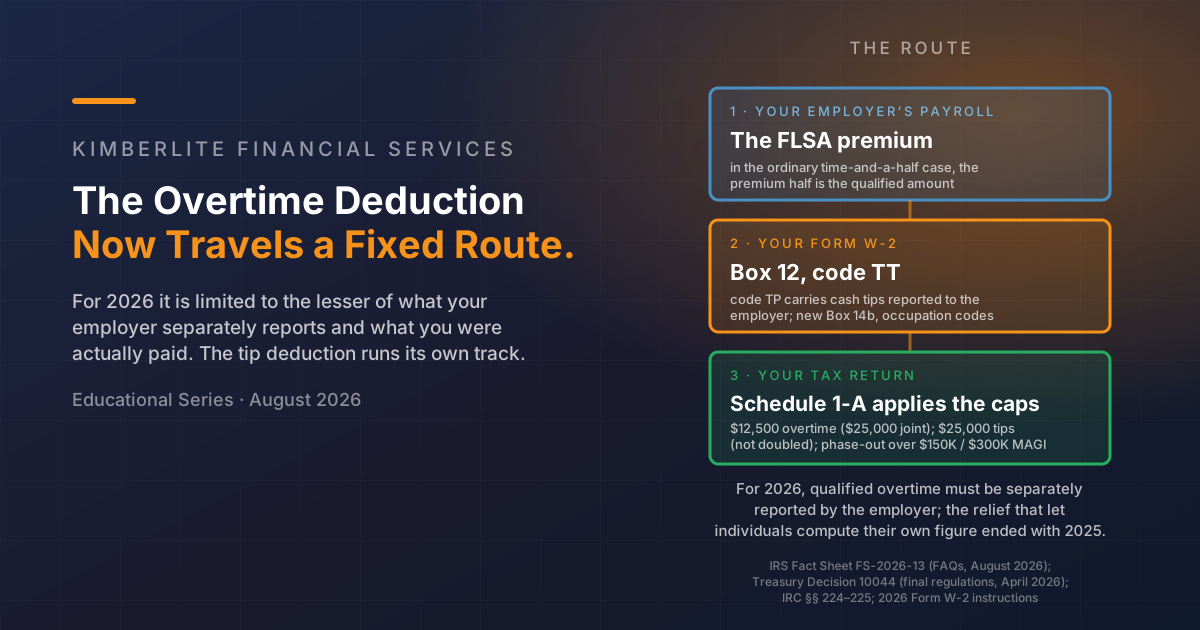
For tax year 2025, the IRS gave individuals published methods for computing qualified overtime themselves. For 2026, IRS guidance states that the qualified overtime deduction is limited to the lesser of what your employer separately reports in Box 12 of your Form W-2 and what you were actually paid, and describes a Form W-2c as the employer's mechanism for correcting a figure that is missing or wrong. The tips deduction has its own machinery, described further down. Roughly four months of pay periods are left in the year.
Most tax provisions are things you claim. The overtime deduction arrives through a chain you can inspect but cannot bypass, and the tips deduction runs partly on its own track. Between the hour you work and the line on your return, the overtime figure passes through several systems, and 2026 is the first year those reporting stops run on the standing rules rather than on transition relief.
On August 6, 2026, the IRS issued IR-2026-88, releasing Fact Sheet FS-2026-13 — a rewrite of the January 2026 questions and answers on the deduction for qualified overtime compensation, superseding FS-2026-01 of January 23, 2026. The IRS says the update was coordinated with the Department of Labor and the Office of Personnel Management. It deletes the material that applied only to 2025 and adds detailed reporting, withholding, computation, and federal-employee rules for the years that follow.
The provisions themselves were enacted by P.L. 119-21, signed July 4, 2025 — the law the IRS refers to as the One, Big, Beautiful Bill Act, and under which the IRS also publishes material headed Working Families Tax Cuts. The IRS uses both headings for material on these provisions.
Start with the size of the thing, because everything after this is mechanics.
Two things about that grid are worth saying plainly before anything else in this post, because they are easy to lose in a piece about paperwork. These are annual deductions, available in each of four tax years, 2025 through 2028. And they do not require itemizing — a worker taking the standard deduction gets them on top of it, which is unusual and is the single most useful feature of both provisions. The overtime ceiling is also well above what the worked example further down produces, so a worker with heavier overtime has room under it.
Two clarifications on the name of the thing. "No tax on overtime" is a widely used shorthand, and the IRS addresses what it means in FS-2026-13: "The deduction for qualified overtime compensation does not mean that overtime compensation is excluded or exempt from gross income." Overtime remains wages for income tax withholding, Social Security, Medicare, and federal unemployment tax purposes; what the law created is a deduction against taxable income. And the deduction runs on the FLSA premium rather than on the whole overtime check. Both facts matter for sizing the benefit, and neither is a criticism of the provision — this post takes no position on the merits of the statute, only on how it reaches a taxpayer.
Here is the whole path, in order. Four of the five stops have a specific thing that can go wrong, each in a different place at a different time of year; the fifth is a choice rather than a risk.
Qualified overtime compensation exists only where overtime is required by section 7 of the Fair Labor Standards Act (29 U.S.C. § 207). The IRS states that a person who is ineligible for overtime under the FLSA does not receive qualified overtime compensation "regardless of other laws or circumstances (such as a collective bargaining agreement) providing for overtime pay." Time-and-a-half in a union contract or under a state law is real pay; it is not automatically a qualified deduction.
FS-2026-13 lists common exemptions from the FLSA's overtime requirement: executive, administrative, and professional employees; outside sales; certain computer occupations; certain commissioned retail and service employees; employees of railroads and air carriers, taxi drivers, certain motor carrier employees, seamen, and local delivery employees on approved trip rate plans; certain seasonal amusement and recreational establishments; and certain agricultural employees. It also adds an answer that matters to small business owners: an employee who owns at least a bona fide 20% equity interest in the enterprise and is actively engaged in its management is generally considered a bona fide executive, exempt from the section 207 overtime requirement, and therefore FLSA overtime-ineligible.
What can go wrong: assuming that because you are paid overtime, you earn qualified overtime. The IRS calls coverage and exemption "a fact-specific determination that depends on the individual's occupation, work activities, and/or earnings" — not something a blog post can settle for you.
Only the premium counts. The IRS formula, restated in FS-2026-13, is: FLSA hours worked over 40 in a workweek × one-half × the employee's FLSA regular rate. In the ordinary time-and-a-half case, that means the qualified portion is the "half," not the "one and one-half."
Two wrinkles the IRS added in August. If an employer pays more than the FLSA requires — double time, for example — only the amount minimally necessary to satisfy section 207 is qualified. The IRS works the example: 10 overtime hours at a $20 regular rate, paid at double time, produces $400 of overtime pay, of which the FLSA required $300, so the qualified overtime compensation is $100. And "regular rate" is a term of art. FS-2026-13 describes it, citing 29 U.S.C. § 207(e), as including all remuneration for employment paid to or on behalf of the employee except certain payments the FLSA excludes, computed by dividing total pay for the workweek by total FLSA hours actually worked — so nondiscretionary bonuses, shift differentials, and commissions can move it above your base hourly rate.
What can go wrong: a payroll system that reports gross overtime pay rather than the FLSA premium, or that has not had a qualified-overtime field configured. This is a mid-year problem with a mid-year fix, which is the reason the calendar matters this once.
Beginning with tax year 2026, payors and employers are required to separately report qualified overtime — most commonly on Form W-2 in Box 12, code TT, and in the rare case of a worker who is an FLSA employee but treated as an independent contractor for tax purposes, on Form 1099-MISC box 14 or Form 1099-NEC box 1d. The 2026 Form W-2 also carries code TP for the total cash tips reported to the employer, and Box 14 has been split so that the new Box 14b can carry up to two Treasury Tipped Occupation Codes.
The amount reported in code TT is the full qualified overtime paid, even where the caps or the phase-out mean you cannot deduct all of it. The IRS example: $30,000 of qualified overtime is reported in full, notwithstanding the $12,500 limit.
What can go wrong: for qualified overtime, this is the stop where you cannot supply your own number. See the next section.
The IRS answer is direct: overtime, including qualified overtime, is subject to federal income tax withholding, and an employer "may not reduce withholding on wages to account for the qualified overtime deduction unless the employee furnishes the employer an updated and valid Form W-4 accounting for the employee's expected deduction for qualified overtime compensation."
The tools for that exist. The 2026 Form W-4 was updated so that its Step 4(b) deductions worksheet accounts for an expected qualified overtime deduction, and the IRS Tax Withholding Estimator was updated as well. Publication 15 (2026) describes the purpose: to let an employee "receive more money in each paycheck instead of waiting until filing their income tax return to receive the full benefit of this deduction."
What this stop actually is: not a failure point but a fork. Doing nothing routes the benefit to your return at filing; filing a new W-4 routes some of it into paychecks, and an overstated Step 4(b) entry can leave you under-withheld.
Both deductions are computed on Schedule 1-A (Form 1040), "Additional Deductions," which also covers the car loan interest deduction and the enhanced deduction for seniors. On the 2025 form the schedule's total flows to Form 1040 line 13b; the 2026 forms were not final as of this writing and the line numbering may change. You start with the full reported figure, then apply the cap and then the MAGI phase-out.
They are available whether you itemize or take the standard deduction. Note where they sit: below the line, after adjusted gross income has already been determined, and alongside the standard deduction rather than inside it. That placement is the reason the Utah section further down says what it says.
What can go wrong: expecting the deduction to equal your overtime pay. In the ordinary time-and-a-half case it is closer to a third of it.
One framing note before the specifics, because it governs everything in this section. The separate-reporting condition itself is statutory — FS-2026-13 grounds it in Internal Revenue Code section 225 and the information-return requirement of section 6051(a)(19). The consequences described below come from an IRS fact sheet FAQ, and the IRS states that its FAQs have not been published in the Internal Revenue Bulletin, "will not be relied on or used by the IRS to resolve a case," and may be updated or modified. They are the agency's current stated position — worth planning around, and not the same thing as a regulation.
With that said: for 2025, Notice 2025-62 gave employers information-reporting penalty relief and Notice 2025-69 gave individuals published methods for computing their own qualified overtime, because the forms had not yet been updated. Those methods were available to any individual whose employer had not separately reported the amount.
FS-2026-13 states that this does not carry forward. An employee "can only deduct qualified overtime compensation that the employee's employer included on a properly furnished Form W-2," and "no relief is available for tax years after 2025." The consequences it then spells out are worth setting out in outline. The first card is the one that is easiest to overlook.
An employer that discovers an error in Box 12, code TT must file a Form W-2c with the Social Security Administration and furnish it to the employee "as soon as possible." Sections 6721 and 6722 provide information reporting penalties for incorrect returns, with reduced penalties for timely corrections. So the correction mechanism is defined — see the card on understated amounts for what the IRS says happens when it is not used.
You may consider only the qualified overtime actually paid — the operative rule is the lesser of what was reported and what you received. The IRS example: $5,000 paid, $10,000 reported in error, $5,000 usable. An inflated box is a problem to raise, not a number to rely on.
You must request the Form W-2c. If the employer is unwilling or unable to furnish one, the IRS says you are "not entitled to use the omitted or understated amount" — even where more qualified overtime was in fact paid. Its example: $10,000 paid, $5,000 reported, no correction, $5,000 deductible.
FS-2026-13 states that a Form 4852 substitute for a Form W-2 does not satisfy the requirement, — the separate-reporting requirement — on the ground that it is not a statement furnished under section 6051(a)(19).
An illustration, using round figures rather than anyone's actual pay. Take a Utah worker with an FLSA regular rate of $28.00 an hour — chosen because it is near the $28.23 mean hourly wage the Bureau of Labor Statistics reported for construction and extraction occupations in the Ogden metropolitan area in its May 2025 estimates, though a mean hourly wage is not itself an FLSA regular rate — working six overtime hours a week for fifty weeks, paid straight time-and-a-half, with no other remuneration affecting the regular rate.
Two things fall out of that table. The first is a rough magnitude check: in the ordinary section 207(a) time-and-a-half case, where the FLSA regular rate equals the base hourly rate, the qualified portion is about a third of overtime pay — time-and-a-half is three halves and only one of them is the premium. It will not be a third if your regular rate includes bonuses, shift differentials, or commissions, or if your employer computes overtime under one of the alternative methods within section 207. Hospitals and certain residential care facilities, public-sector fire protection and law enforcement employees paid on a workweek basis, and state and local employees receiving compensatory time each have their own rules, and in those cases the IRS says the overtime premium actually paid under that provision is what determines the qualified amount. Use the one-third figure only to spot an order-of-magnitude mismatch.
The second is the last line, which reflects how Utah's starting point interacts with a below-the-line federal deduction. That is the subject of the next section.
Utah's individual income tax starts from federal adjusted gross income. Utah Code § 59-10-103 defines a resident individual's state taxable income as federal adjusted gross income after the additions and subtractions required by § 59-10-114 and the adjustments required by § 59-10-115, and defines adjusted gross income by reference to section 62 of the Internal Revenue Code. The 2025 Form TC-40 follows that structure: the form's opening computational lines run from federal adjusted gross income on line 4, through Utah's own additions and subtractions, to Utah taxable income on line 9 — without passing through any below-the-line federal deduction. Note also that the federal phase-out described below runs on modified adjusted gross income, which begins from AGI and adds back certain excluded foreign and territorial income; for most Utah filers the two are the same number.
The tips and overtime deductions never touch that number. They sit below the line on Schedule 1-A, after adjusted gross income has been determined.
We looked for a Utah subtraction, exemption, or credit for tips or overtime and did not find one. Utah Code § 59-10-114's list of subtractions from adjusted gross income does not include tips or overtime; the taxpayer tax credit under § 59-10-1018 is built on the federal standard deduction or the Utah itemized deduction plus the Utah personal exemption, and Schedule 1-A deductions are neither. That review covered the two parts of the statute where such a provision would live for individuals, not the entire tax code, and the Utah Legislature could of course address the question in a future session.
What Utah did change for 2026 is the rate. Senate Bill 60 of the 2026 General Session lowered the individual income tax rate under § 59-10-104 from 4.50% to 4.45%, with retrospective operation for taxable years beginning on or after January 1, 2026. Utah's statutory rate went down for 2026. It arrived from a different direction than the federal deductions did.
The tips deduction runs on a parallel track with its own machinery, and 2026 is the first year the machinery is fully assembled.
On April 13, 2026, Treasury and the IRS published final regulations — Treasury Decision 10044, 91 Fed. Reg. 19026, effective June 12, 2026 — listing the occupations that customarily and regularly received tips on or before December 31, 2024. The final list contains 71 occupations across eight categories: beverage and food service; entertainment and events; hospitality and guest services; home services; personal services; personal appearance and wellness; recreation and instruction; and transportation and delivery. Each carries a Treasury Tipped Occupation Code. The announcing release, IR-2026-49, described the list as covering "more than 70" occupations; the count of 71 comes from the codified table. The regulations state that the list of occupations is exhaustive while the illustrative examples within each code are not.
The 2026 Form W-2 splits Box 14 into 14a and 14b, with 14b carrying up to two Treasury Tipped Occupation Codes. The employee instructions state that if code 000 is used and no other code is included in Box 14b, the cash tips in Box 12 code TP are not qualified tips and should not be used for the deduction.
The final regulations maintain that automatic gratuities and service charges are not qualified tips; the customer must be expressly given the option to disregard or modify the amount. The IRS example is the automatic 18% added to a large party's check. That is compensation, and it may well be wages that count toward overtime, but it is not a tip for this purpose.
The final regulations exclude all digital assets from the definition of cash tips, a change from the proposed version, and newly clarify that amounts paid in foreign currency are included. Casino chips remain included. "Cash tips" otherwise covers tips received in cash, charged tips, and tips under a tip-sharing arrangement.
The statute excludes tips earned in a specified service trade or business, but Treasury expressly did not finalize that rule — the relevant paragraph of the regulation is reserved, and the agencies said they intend to issue proposed regulations and take comment first. Anyone whose situation turns on that exclusion should treat it as an open question and get individual advice.
The tips deduction is also available to self-employed individuals and to non-employees who receive Forms 1099, not only to W-2 employees, subject to a statutory limitation that ties the amount taken into account to the income of the trade or business. That is one place where the tips deduction and the overtime deduction genuinely diverge, and it is worth stating plainly: the employer-reporting discussion earlier in this post — the lesser-of rule, the Form W-2c, the Form 4852 answer — is drawn from IRS guidance about qualified overtime. This post does not describe an equivalent rule for tips, and a self-employed tipped worker has no employer reporting anything. What the post does describe on the tips side is the occupation list, the Box 14b code, the service-charge line, the caps, and the phase-out.
The cap difference is also easy to miss: the overtime deduction's limit is expressly doubled on a joint return, and the tips deduction's $25,000 is set without that doubling. A household with two tipped earners should confirm with a tax professional how the limit applies to them.
Two local features make this more than an abstraction here.
The first is the occupational mix. In the Bureau of Labor Statistics' May 2025 estimates for the Ogden metropolitan area — Davis, Morgan, and Weber counties — food preparation and serving occupations accounted for 8.4% of employment, construction and extraction 6.5%, transportation and material moving 7.5%, production 7.6%, healthcare support 3.5%, personal care and service 2.6%, and protective service 1.3%. Construction and extraction is notably concentrated here, with about 17,550 jobs and a location quotient of 1.57 against the national average. Several of these categories appear on the Treasury occupation list, and several are ones in which hourly, overtime-eligible work is usual — which is a different statement from saying that any particular worker in them is eligible — that turns on the individual's duties, earnings, and employer, not on an occupational code.
The second is the federal payroll. FS-2026-13 devotes an entire section to federal employees. Hill Air Force Base's fiscal year 2024 economic impact statement reports 14,151 government civilians within a total workforce of 26,893, and the Kem C. Gardner Policy Institute counted 14,567 federal civilian jobs in Davis County — about 10.1% of all employment in the county — using average job counts for the third quarter of 2023 through the second quarter of 2024.
Both statutes use identical phase-out language: the deduction is reduced, but not below zero, by $100 for each $1,000 by which modified adjusted gross income exceeds $150,000, or $300,000 on a joint return. The reduction applies after the cap.
For most households in this part of the state the phase-out is not the binding constraint. Census Bureau QuickFacts, drawing on the American Community Survey's 2020–2024 five-year estimates in 2024 dollars, put median household income at $95,166 for Utah, $110,884 for Davis County, and $102,480 for Layton — all below the $150,000 single and $300,000 joint thresholds. Household income and modified adjusted gross income are different measures on different bases, and that comparison is directional context rather than a statement about any household's eligibility. We found no source quantifying what share of Utah filers sit below the thresholds, and we are not going to invent one.
Kimberlite Financial Services offers financial planning engagements ranging from a single-topic project plan to comprehensive and complex-tier engagements that connect cash flow, debt, tax considerations, insurance needs, and long-term goals into one picture. We do not prepare tax returns or provide tax advice; at the complex tier the engagement includes coordination with your CPA or tax preparer. Advisory services are provided for compensation; our services, fees, and conflicts of interest are described in Form ADV Part 2A and Form CRS, available on request and at adviserinfo.sec.gov.
Educational Content Only. This content is provided by Kimberlite Financial Services for educational and informational purposes only. It is not personalized tax, investment, legal, accounting, payroll, or employment advice, and should not be relied upon as such. Nothing in this post is a recommendation to buy, sell, or hold any security; to make or avoid any change to an investment portfolio; to open, close, or fund any account; or to take, decline, or restructure any employment, any hours of work, or any compensation arrangement. General observations about where to look on a pay statement or a form, what a person might ask an employer or a tax professional, and the existence of a withholding choice are educational points offered to a general audience; they are not tailored to any individual's circumstances and are not a recommendation regarding any person's tax return, withholding election, employment, or dealings with an employer. The information reflects publicly available statutes, regulations, agency guidance, government data, and forms as of the publication date and may become outdated.
What Kimberlite Financial Services is not. Kimberlite Financial Services is not a certified public accounting firm, tax return preparer, enrolled agent, payroll provider, employer, employment agency, law firm, or government agency. It does not prepare tax returns, provide tax advice, compute payroll, determine any worker's status under the Fair Labor Standards Act, issue or correct Forms W-2, represent taxpayers before the Internal Revenue Service or the Utah State Tax Commission, or practice law. Descriptions of the Fair Labor Standards Act, of federal and Utah tax statutes and regulations, and of federal personnel forms and procedures are general summaries of publicly available material, not legal or tax conclusions about any individual's situation. Whether a particular worker is covered by and not exempt from the FLSA's overtime requirement is a fact-specific determination that this post does not and cannot make. Anyone with a question about their own eligibility, reporting, or return should consult a qualified tax professional; questions about wage and hour status or a specific Form W-2 belong with the employer, its payroll provider, or the U.S. Department of Labor.
Authority of the sources described. The separate-reporting condition described in this post is statutory, and Treasury Decision 10044 is a final regulation. Fact Sheet FS-2026-13 is a set of frequently asked questions, and the IRS states that its FAQs have not been published in the Internal Revenue Bulletin, will not be relied on or used by the IRS to resolve a case, and may be updated or modified. Where this post describes consequences drawn from that fact sheet, it is describing the agency's current stated position, not a regulation and not a guarantee of how any matter will be resolved. The Utah State Tax Commission material described is a training presentation rather than a formal publication, notice, or rule.
Illustrations are hypothetical; third-party figures are theirs. The $28.00-per-hour overtime illustration and every figure derived from it — 300 overtime hours, $12,600 of gross overtime pay, $4,200 of qualified overtime compensation, the approximately $504 and $924 federal tax reductions at assumed 12% and 22% marginal rates, the $0 Utah effect, the approximately one-third rule of thumb, the $14,000/$170,000 MAGI phase-out example producing a $10,500 deduction, the statement that the single-filer annual overtime ceiling of $12,500 is about three times the illustration's $4,200, and the rounded restatements of any of the foregoing that appear elsewhere in the post — are simple arithmetic performed by Kimberlite Financial Services on assumed facts and on published third-party figures. They do not describe any actual person, employer, wage, pay period, Form W-2, or tax return. They ignore Social Security, Medicare, and unemployment taxes, state and local taxes other than as expressly stated, credits, other phase-outs, and every other feature of a real return, and they assume the taxpayer is otherwise eligible. Marginal tax rates are assumed for illustration and are not a statement of any reader's bracket; the value of a deduction depends on the reader's own marginal rate, which may be higher or lower than those assumed. These are not quotes, offers, projections, guarantees of any tax result, or performance results. Individual results will differ. Figures drawn from the Bureau of Labor Statistics, the Census Bureau, Hill Air Force Base, and the Kem C. Gardner Policy Institute come from different sources with different reference periods, geographies, and methodologies and are not directly comparable to one another; each is labeled with its own vintage above. A mean hourly wage published by BLS is not an FLSA regular rate.
Third parties are described, not evaluated. References to government agencies, forms, publications, and research organizations are factual descriptions drawn from the cited sources. They are not recommendations, endorsements, disparagements, or ratings. Kimberlite Financial Services receives no compensation from any organization named in this post. Where this post notes that some third-party websites describe the Utah tax treatment in a way that conflicts with the Tax Commission's description, no specific site is identified, rated, evaluated, or disparaged; the pages relied on for that observation were captured into the firm's substantiation file, and the point is made only so that a reader who encounters a conflicting description knows the question exists.
No predictions. Kimberlite Financial Services does not predict tax legislation, regulations, agency guidance, enforcement practices, employer payroll practices, income tax rates, interest rates, inflation, economic growth, or securities markets, and nothing in this post should be read as such a prediction. Nothing here forecasts what any employer will report, or when. Statements about the Internal Revenue Code, Treasury regulations, IRS forms and fact sheets, Department of Labor and Office of Personnel Management rules, and Utah statutes and administrative practice describe the status as of the publication date only and may change. At least one relevant regulatory provision — the specified service trade or business exclusion for qualified tips — has expressly not been finalized, and this post takes no position on how it will be resolved. The deductions described here are scheduled by statute to apply only to taxable years beginning after December 31, 2024 and before January 1, 2029. Past law and past data do not indicate future results.
Political neutrality. This post describes an enacted federal statute and the guidance issued under it. It takes no position on the merits of that statute, on any proposal to extend, amend, or repeal it, on any related state legislation, or on any political party, official, candidate, or campaign. Where more than one name for the same law appears in official materials, each is noted only so that readers can locate the relevant guidance.
Registration and affiliations. Kimberlite Financial Services LLC is an investment adviser registered with the State of Utah. It may transact business only in states where it is registered or is excluded or exempt from registration. Kimberlite Financial Services is not affiliated with the Internal Revenue Service, the U.S. Department of the Treasury, the U.S. Department of Labor, the Office of Personnel Management, the Social Security Administration, the U.S. Bureau of Labor Statistics, the U.S. Census Bureau, the U.S. Department of the Air Force or Hill Air Force Base, the Library of Congress, the U.S. Postal Service, the Postal Regulatory Commission, the Tennessee Valley Authority, the Utah State Tax Commission, the Utah State Legislature, the University of Utah or the Kem C. Gardner Policy Institute, or any other government agency, research organization, or educational institution named above.
Conflict of Interest Disclosure. Ryan J. Hammett is the sole member of Kimberlite Insurance Services LLC, a separate, affiliated insurance agency, and is a licensed insurance producer who may receive commissions on insurance products sold through that entity. This creates a conflict of interest with respect to any discussion of insurance. The body of this post does not discuss, evaluate, or recommend any insurance product, plan, or carrier. The planning engagement described in the call to action above may include discussion of insurance needs; where it does, this conflict applies, and any insurance product would be placed through Kimberlite Insurance Services LLC on a commission basis.
Before making any financial, tax, employment, or legal decision, consult a qualified professional who can evaluate your specific situation. Kimberlite Financial Services makes no representations or warranties regarding the completeness or accuracy of the information presented.