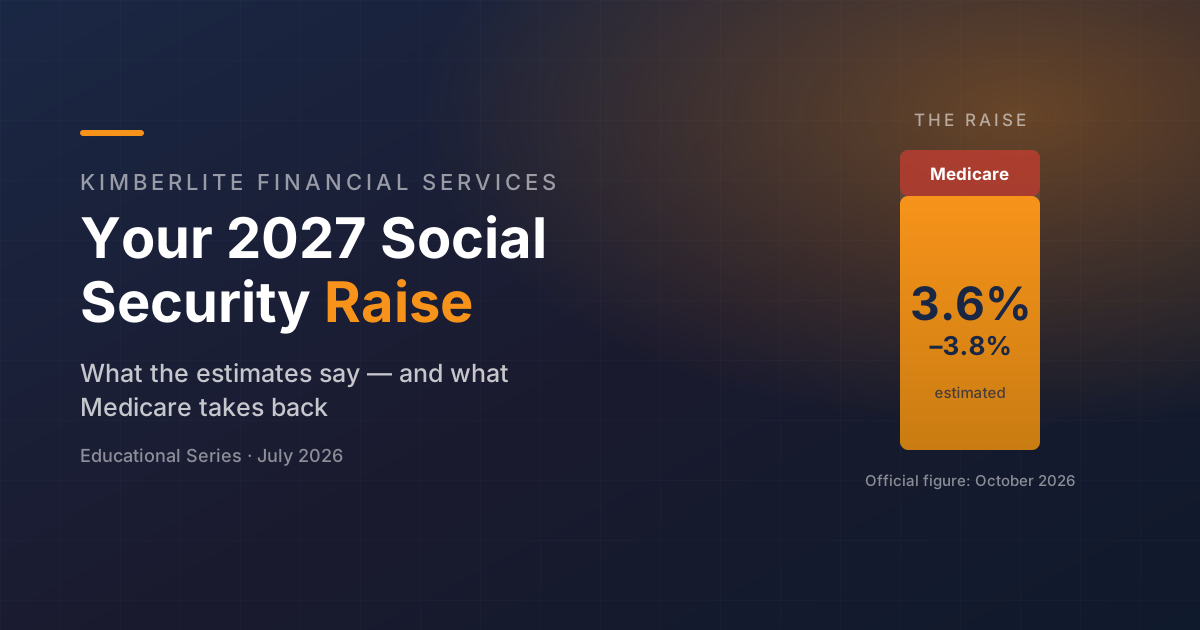
June's inflation report sent forecasters scrambling to revise the 2027 cost-of-living adjustment. The headline number is only half the story — the other half arrives as a deduction from the same check.
In the days after the June inflation data landed on July 14, "2027 COLA," "Social Security increase," and "Medicare premium 2027" surged across search. Here's how the number is actually calculated, why the estimates keep moving, what Medicare is projected to take back, and the three planning items that matter far more than the headline percentage.
Every July, the same thing happens. The Bureau of Labor Statistics releases an inflation report, a handful of organizations update their cost-of-living adjustment forecasts, and roughly 70 million Americans go looking for one number: how much bigger will next year's Social Security check be?
This July the answer moved — a lot. And the reason it moved is worth understanding, because it says something about how this benefit actually works, and about a second number that almost never makes the headline.
Independent analyst Mary Johnson cut her own forecast by a full percentage point after the June data — from 4.7% down to roughly 3.7%. That is an unusually large single-month revision, and it illustrates the most important thing to understand about every COLA estimate you will read between now and autumn: they are projections built on incomplete data, and they move.
For context, the 2026 COLA came in at 2.8%. If a figure in the 3.6%–3.8% range holds, 2027 would deliver a noticeably larger adjustment than this year. Whether it holds is a different question.
The COLA is not a policy decision, a vote, or an act of generosity. It is a formula, and knowing the formula tells you exactly why the estimates behave the way they do.
Three consequences fall out of that, and they explain nearly everything about the current news cycle:
Practical translation: a July estimate is a weather forecast for a storm that has just started forming. Useful for orientation. Not something to build a budget around.
Most people who receive Social Security also have Medicare Part B premiums deducted directly from that check. So the figure that actually reaches the bank account is the COLA minus whatever Medicare costs change by — and 2026 was a rough reminder of how much that second number matters.
The 2026 increase of nearly 10% was large enough that it consumed a meaningful share of this year's 2.8% adjustment for many beneficiaries. The Trustees' projection for 2027 is far gentler. Several private forecasters, citing a pattern of the Trustees under-projecting, put the figure higher. Nobody will know until the Centers for Medicare & Medicaid Services publishes the official numbers late this year.
These are illustrations using a round benefit amount and published projections — not predictions, and not applicable to any specific person's situation. Your own figures depend on your benefit amount, your Medicare enrollment, your income, and the official numbers that have not been released yet.
There is also a protection worth knowing about. The hold harmless provision generally prevents a Part B premium increase from reducing a beneficiary's net Social Security check below the prior year's amount. It is a real safeguard — but a limited one. It generally does not apply to people new to Medicare, to those who pay Part B directly rather than through a Social Security deduction, or to people paying income-related surcharges. And it only binds when the Part B increase exceeds the COLA dollar amount — a condition that published commentary suggests is unlikely to be met in 2027 unless the COLA comes in far lower than current estimates.
A federal program that has been holding down stand-alone prescription drug plan premiums is scheduled to end after December 31, 2026. Reporting on the projections suggests a substantial share of Part D enrollees could see monthly premiums rise, though some may see no increase or a decrease. Part D is a separate decision from Part B — and open enrollment is the window to review it.
The income thresholds that determine whether Social Security benefits are taxable — $25,000 for single filers, $32,000 for joint — were set by the 1983 Social Security Amendments, effective 1984, and have never been indexed to inflation. The $34,000 / $44,000 tier dates to 1993. Benefits rise with the COLA every year; the thresholds do not. Over time, that arithmetic pulls more households into taxation of benefits.
Higher-income beneficiaries pay income-related surcharges on Parts B and D, based on the tax return from two years earlier. In 2026 the first threshold is $109,000 (single) or $218,000 (joint) in modified AGI. Cross it by one dollar and the full surcharge applies — roughly $81 more per month for Part B plus about $15 for Part D, per person.
Between the July forecasts and the October announcement, the 2027 COLA will be reported, revised, and re-reported many times. The percentage is worth watching. It is not, however, the number that determines how a retirement year actually goes.
What determines that is the whole picture: the gross benefit, minus Medicare, adjusted for how much of the benefit is taxable, in the context of whatever else the household draws on. The headline percentage describes only the first line of that calculation. The deposit that arrives in January reflects all of it — which is why the arithmetic, and not the announcement, is the part worth planning around.
Kimberlite Financial Services offers educational retirement income reviews that map Social Security timing, Medicare costs, IRMAA thresholds, and the taxation of benefits as one connected picture — in the context of a complete financial plan.
Educational Content Only. This content is provided by Kimberlite Financial Services for educational and informational purposes only. It is not personalized investment, tax, legal, insurance, or Social Security claiming advice and should not be relied upon as such. Nothing in this post is a recommendation regarding any benefit election, insurance product, Medicare plan, or security. The information presented reflects publicly available reporting and government data as of the date of publication and may become outdated.
All 2027 cost-of-living adjustment and Medicare premium figures discussed are estimates or projections published by third parties, not official amounts. The official 2027 Social Security COLA is scheduled to be announced by the Social Security Administration in October 2026, and official 2027 Medicare premiums, deductibles, and income-related monthly adjustment amounts are scheduled to be published by the Centers for Medicare & Medicaid Services later in 2026. Actual figures may differ materially from the projections described here. Dollar illustrations use a hypothetical round benefit amount for arithmetic clarity and do not represent any individual's benefit, results, or experience.
Tax law, benefit rules, and Medicare provisions change, and certain provisions referenced are scheduled to expire. Kimberlite Financial Services is not affiliated with, endorsed by, or acting on behalf of the Social Security Administration, the Centers for Medicare & Medicaid Services, or any other government agency. Kimberlite Financial Services LLC is an investment adviser registered with the State of Utah.
Conflict of Interest Disclosure. Ryan J. Hammett is the sole member of Kimberlite Insurance Services LLC, a separate, affiliated insurance agency, and is a licensed insurance producer who may receive commissions on insurance products sold through that entity. This creates a conflict of interest with respect to any discussion of insurance-related products. This post does not recommend any insurance product, Medicare Part D plan, Medicare Advantage plan, or Medicare Supplement policy, and Kimberlite Financial Services does not receive compensation from any Medicare plan sponsor, insurer, or government agency in connection with this content.
Before making any financial, tax, benefit, or Medicare decision, consult with a qualified professional who can evaluate your specific situation. Kimberlite Financial Services makes no representations or warranties regarding the completeness or accuracy of the information presented.