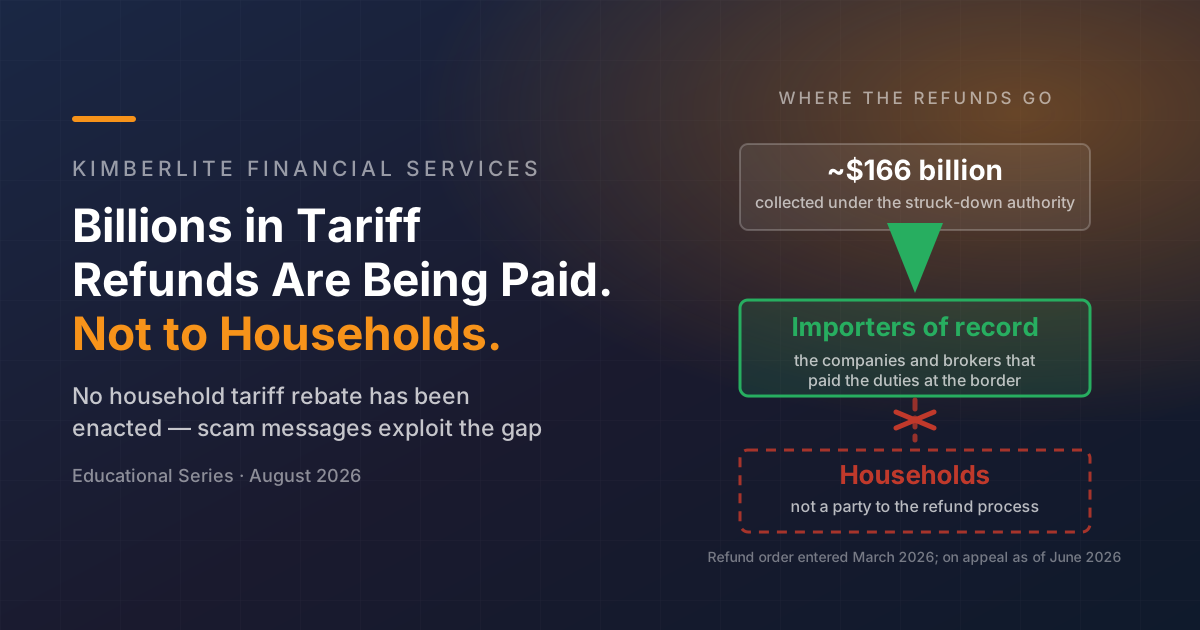
"Tariff rebate check" and "$2,000 tariff dividend" are circulating everywhere this month. A real refund process does exist, created by a real Supreme Court ruling, moving real money. It pays importers, not consumers — and no household payment has been enacted. Here is what's actually in front of you.
Two things are true at once, and the gap between them is where the scams live. Billions of dollars in tariff refunds really are being processed under a Supreme Court ruling. And the households searching for a check are not in that process. Understanding why takes about ten minutes and is worth considerably more than that.
If you have received a message this summer about a "tariff refund," a "tariff dividend," or a $2,000 direct deposit waiting for you to claim, you are not unusual. Phrases like tariff rebate check, stimulus check 2026, and $2,000 tariff dividend have been generating enough consumer interest that the IRS, the Federal Trade Commission, and multiple state consumer protection agencies have all published warnings about fraud built on top of them.
That volume is the story. It means a very large number of people are trying to find out whether money is coming. That is a reasonable thing to want to know, and the answer is knowable — it just isn't the answer the text message gave you.
The third number is the one almost nobody explains, and explaining it is most of the work of this post.
Nearly all of the confusion collapses once these three categories are kept apart.
On February 20, 2026, the Supreme Court ruled 6–3 in Learning Resources v. Trump that the International Emergency Economic Powers Act does not authorize the President to impose tariffs. Roughly $166 billion had already been collected under that authority. The Court of International Trade ordered relief in Atmus Filtration v. United States on March 4, and Customs and Border Protection built a dedicated refund system inside its Automated Commercial Environment. Refunds are being processed in phases.
H.R. 7865, the American Consumer Tariff Rebate Act of 2026, was introduced March 9 and would create one-time rebates from a pool capped near $231 billion, scaled by filing status with an additional amount per qualifying child. A Senate bill introduced March 12 would provide $1,200 to joint filers below an income threshold plus $600 per qualifying child. Both were referred to committee, which is automatic on introduction. Neither has advanced beyond that as of this writing.
The $2,000 figure traces to public statements by the President beginning in November 2025 proposing a tariff-funded "dividend of at least $2,000 a person." Congress has not authorized such a payment, no agency has been directed to pay one, no amount is fixed in law, and no date exists. What is outright fabricated is everything the messages add on top: an IRS payment schedule, a registration portal, a direct-deposit date, and a request to verify your bank details.
That distinction — who legally pays a tax versus who ultimately bears its cost — is one of the oldest ideas in public finance, and it is exactly what makes this situation confusing. Economists generally hold that some share of a tariff's cost reaches consumers through higher prices. The legal refund mechanism does not address that. It refunds the party that wrote the check to Customs.
One more thing that almost no consumer coverage mentions. The March 4 order was broad — it directed relief for importers generally, not only those who had sued. Two days later the court suspended immediate compliance while CBP built a workable process, and on June 2, 2026 the Justice Department appealed to the Federal Circuit, arguing that relief should be narrower. The dedicated CBP refund module opened in phases beginning April 20, and it does not cover every category of entry.
So even for the businesses actually entitled to these refunds, the scope, timing, and total are unsettled and subject to an appeal that has not been decided. That is worth knowing before evaluating any claim that money is about to arrive somewhere.
Something else happened in late July that most coverage of the "rebate check" question skipped.
The 10% global tariff imposed under Section 122 of the Trade Act of 1974 expired by operation of law at 12:01 a.m. Eastern on July 24, 2026. Section 122 carries a statutory time limit and Congress did not extend it. That tariff had also drawn its own challenge: on May 7, 2026 the Court of International Trade held the underlying proclamation invalid, but limited relief and refunds to the named plaintiffs and one state, and the Federal Circuit stayed that order pending appeal. Collection from other importers continued until expiration.
At the moment Section 122 lapsed, a replacement took effect: a two-tier duty of 10% or 12.5% imposed under Section 301, arising from a USTR forced-labor investigation and applied to roughly 60 economies accounting for nearly all U.S. imports. On August 3, twenty-five states filed suit in the Court of International Trade seeking to block that action and recover duties paid under it. CBP has continued to collect at the stated rates.
If no household check is coming, what do the tariffs actually cost a household?
The most-cited current answer comes from the Budget Lab at Yale, whose State of U.S. Tariffs tracker was updated on August 11, 2026. It estimates the annual cost of current-law tariffs at about $1,100 per household, with an ultimate consumer price-level impact of roughly 0.7%. The Tax Foundation, using a different model, publishes an average household figure of about $900 for 2026.
Those are model outputs describing a forward-looking annual burden under current law. No household received an itemized statement, and neither figure is a measurement of money already spent. Both have also moved substantially as policy changed — the Budget Lab's household figure was around $570 in a March analysis, when the average tariff rate was lower. That is not a knock on the modeling; it reflects an underlying tariff schedule that kept changing. It does mean these should be read as estimates with real uncertainty around them.
The distributional picture is also worth stating, and it cuts in a direction that surprises people. The Budget Lab's March 2026 distributional work estimated the annual cost, in 2025 dollars, at roughly $315 for households in the bottom tenth of the income distribution and roughly $1,325 for the top tenth — about four times as many dollars. But measured as a share of after-tax income, those same figures represented roughly 0.8% for the bottom tenth and 0.3% for the top, which is what economists mean when they call a tariff regressive. Higher-income households pay more dollars; lower-income households give up more of their income. Those figures come from an analysis at a lower average tariff rate than the current $1,100 estimate, so they describe the shape of the burden rather than its current level.
Here is where a lot of confident commentary goes wrong in both directions, and it is worth walking through slowly.
The July Consumer Price Index, released August 12, showed the all-items index up 0.1% for the month and 3.4% over the year, down from 3.5% in June. Core CPI — all items less food and energy — rose 0.2% for the month and 2.5% over the year, down from 2.6%.
Look at the category where tariffs should show up most directly. Commodities less food and energy commodities — physical goods, the things that cross a border in a container — rose 0.2% in July and just 0.8% over the past 12 months.
It is very tempting to look at that 0.8% and conclude the tariff cost estimates are overblown. That inference does not work, for three separate reasons, and each one is worth understanding on its own.
The honest conclusion is narrower than either side of the argument you will hear. Tariffs carry a cost, credible published estimates put it in the high hundreds to low thousands of dollars per household per year, those estimates are model-derived and have moved as policy moved, and a single month of CPI cannot confirm or refute them. Any single tariff cost figure quoted without the model and the timing assumptions behind it is doing more asserting than measuring.
Public interest attracts fraud. It always has. This particular topic is close to ideal for it: a plausible government payment, a real court ruling to point at, real money genuinely moving, and a great many people actively looking for information.
The federal data gives a sense of scale. The Federal Trade Commission reported in June 2026 that people lost $3.5 billion to imposter scams in 2025, with roughly $920 million of that going to scammers impersonating government agencies — up from about $789 million the year before. Government impersonation is not a niche category. It is one of the largest.
The IRS published its 2026 Dirty Dozen list of tax scams on March 5. Listed first is IRS impersonation by email and text — messages using official-looking language and QR codes to route people to fake IRS websites to "verify" an account or "claim" a refund; in that same discussion the IRS reported over 600 social media impersonators during fiscal year 2025. Listed second is AI-enabled phone impersonation using spoofed caller ID. Listed fourth is misleading tax advice spreading on social media. The list does not name tariff refunds specifically; the tariff-refund pitch is simply the current dressing on the pattern it describes, and state consumer protection agencies have issued warnings naming it directly.
The Supreme Court struck down a tariff authority in February. Roughly $166 billion was collected under it, and Customs and Border Protection is processing refunds in phases — to the importers of record who paid the duties, under an order that the government has appealed. No household is a party to that process. Two bills that would send money to households were introduced in March and have not moved since. There is no enacted federal tariff rebate, no payment date, and no registration.
On the cost side, published models put the annual household burden of current-law tariffs somewhere in the neighborhood of $900 to $1,100 — roughly $75 to $92 a month, or between about 0.9% and 1.2% of Utah's median household income. Those are estimates, they have changed as the policy changed, and the July CPI cannot be used to check them for reasons that are worth understanding rather than glossing over.
What is not in dispute is the fraud. Government impersonation scams took roughly $920 million from Americans last year, IRS impersonation by text and email sits at the top of the IRS's 2026 Dirty Dozen list, and this particular topic hands scammers a real headline to hide behind.
The useful takeaway is small and durable: an unsolicited text about a government payment is not how federal payments are announced, no legitimate refund requires a fee, and the status of any bill in Congress is public and free to check. Multiple tariff matters remain in active litigation as of this writing, and the Budget Lab describes further rate increases as scheduled between now and December — so the specifics in this post have a short shelf life. The rule about the text message does not.
Kimberlite Financial Services offers educational planning reviews that connect cash flow, taxes, debt, insurance, and long-term goals into one picture — so that decisions get made from your actual numbers rather than from headlines. Advisory services are provided for compensation; our services, fees, and conflicts of interest are described in Form ADV Part 2A and Form CRS, available on request and at adviserinfo.sec.gov.
Educational Content Only. This content is provided by Kimberlite Financial Services for educational and informational purposes only. It is not personalized investment, tax, legal, customs, trade, or benefits advice, and should not be relied upon as such. Nothing in this post is a recommendation to buy, sell, or hold any security; to make or avoid any change to an investment portfolio; to open, close, or fund any account; to purchase any product; or to file, refrain from filing, or take any position on any claim, return, or application. The information reflects publicly available reporting, court decisions, agency publications, and government data as of the date of publication and may become outdated quickly.
Legal and legislative status is described, not predicted. Descriptions of court decisions, agency procedures, tariff authorities, and pending legislation are summaries of publicly reported developments as of the publication date and are not legal advice or legal conclusions. Multiple tariff matters are in active litigation, including an appeal of the refund order described above, and pending bills may be amended, may advance, or may fail. Status may change at any time. Kimberlite Financial Services is not a law firm, customs broker, trade consultant, or tax preparer, does not practice law, and expresses no view on the merits of any pending case or bill or on the underlying policy. Anyone with a potential refund claim, filing obligation, or tax question should consult a qualified attorney or tax professional.
Illustrations are hypothetical; third-party estimates are theirs. The per-month, per-week, and percentage-of-income figures are simple arithmetic performed by Kimberlite Financial Services on published third-party estimates and stated assumptions. Household tariff cost figures are forward-looking model outputs published by the Budget Lab at Yale and the Tax Foundation; they are estimates subject to those organizations' methodologies and assumptions, have been revised over time, and do not reflect any individual household's actual spending, income, or tax situation. They are not measurements of amounts paid, quotes, offers, projections, or performance results. Actual results will differ.
No predictions. Kimberlite Financial Services does not predict the direction of tariffs, trade policy, legislation, litigation outcomes, inflation, interest rates, economic growth, or securities markets, and nothing in this post should be read as such a prediction. Statements about what has or has not been enacted describe the status as of the publication date only. Past market movements do not indicate future results.
Fraud information is general. Descriptions of scam patterns and reporting channels are drawn from published IRS and FTC materials, from published state consumer protection agency warnings, and from contemporaneous consumer press reporting. They are general consumer information, not an assessment of any specific message, website, or communication you may have received. The IRS Dirty Dozen list cited here does not name tariff refunds specifically. Kimberlite Financial Services does not investigate fraud, recover funds, or provide identity theft remediation services. If you believe you have been defrauded or that your identity has been compromised, contact the IRS, the FTC at reportfraud.ftc.gov, the Utah Division of Consumer Protection, and your financial institution directly.
Registration and affiliations. Kimberlite Financial Services LLC is an investment adviser registered with the State of Utah. Kimberlite Financial Services is not a bank, credit union, or broker-dealer; is not affiliated with the Internal Revenue Service, the U.S. Department of the Treasury, U.S. Customs and Border Protection, the Office of the U.S. Trade Representative, the U.S. Supreme Court, the U.S. Court of International Trade, the Federal Trade Commission, the Bureau of Labor Statistics, the U.S. Census Bureau, the Federal Reserve System or any Federal Reserve Bank, the Budget Lab at Yale, the Tax Foundation, the Utah Division of Consumer Protection, or any other government agency or research organization; and receives no compensation from any of the third-party research organizations or news sources cited above in connection with this content.
Conflict of Interest Disclosure. Ryan J. Hammett is the sole member of Kimberlite Insurance Services LLC, a separate, affiliated insurance agency, and is a licensed insurance producer who may receive commissions on insurance products sold through that entity. This creates a conflict of interest with respect to any discussion of insurance. This post does not discuss or recommend any insurance product, plan, or carrier.
Before making any financial, investment, tax, or legal decision, consult a qualified professional who can evaluate your specific situation. Kimberlite Financial Services makes no representations or warranties regarding the completeness or accuracy of the information presented.