On July 4, 2026, one of the most searched-for financial products in years officially opened for enrollment. Millions of families signed up in the first week. Here's what the account actually is — and what it isn't.
Trump Accounts were created by federal legislation passed in July 2025 and went live for contributions on July 4, 2026. In the days since, the IRS reports that more than 4 million children have been signed up, with over 1 million families claiming the $1,000 federal pilot contribution.
That kind of launch generates a lot of headlines and a lot of confusion in roughly equal measure. This post is an educational walk-through of how the account works, how it's taxed, and how it compares to the savings vehicles families already use. Not advice. Not a recommendation. Just a map.
What a Trump Account Actually Is
A Trump Account is a new type of tax-deferred investment account for children, created under Section 530A of the tax code. Any U.S. citizen child under 18 with a Social Security number can have one — opened by a parent or guardian at no cost through TrumpAccounts.gov or the official app.
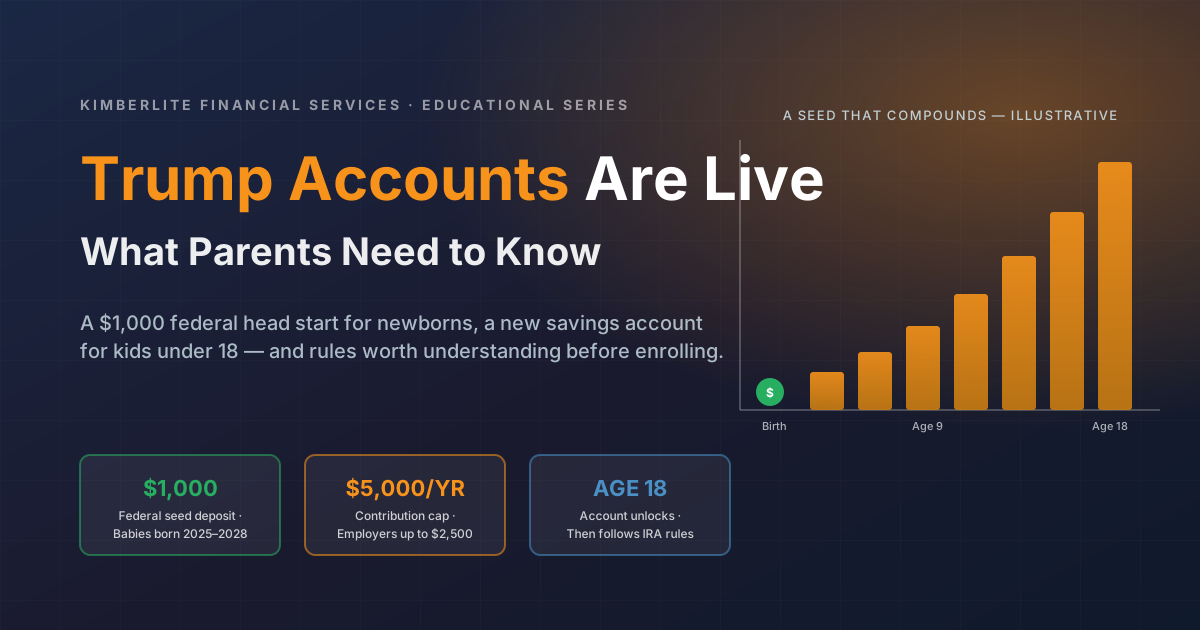
$1,000
One-time federal deposit for eligible children born 2025–2028
$5,000/yr
Annual contribution cap for 2026–2027 (indexed for inflation afterward)
$2,500
Maximum annual employer contribution, excluded from taxable income
Age 18
No withdrawals before then; the account then follows traditional IRA rules
The one-sentence version: It's a locked, low-cost U.S. stock index account that the government seeds with $1,000 for babies born 2025 through 2028, that anyone can add to up to $5,000 a year, and that turns into something very much like a traditional IRA when the child turns 18.
The $1,000 Pilot Program: Who Qualifies
The headline feature is the one-time $1,000 Treasury deposit. To receive it, a child must be a U.S. citizen born between January 1, 2025 and December 31, 2028, with a Social Security number, and a parent or guardian must make the election — one per child. Children born outside that window can still have a Trump Account; they just don't receive the federal seed money.
There is no income limit and no cost to claim it. For families who qualify, this is one of the rare cases in personal finance where money is simply available for filling out a form.
The Rules That Matter
Money In
- Up to $5,000/year total, after-tax (not deductible)
- Parents, relatives, and friends can contribute
- Employers can add up to $2,500/year tax-free (counts toward the cap)
- Government and charitable contributions don't count toward the cap
- Contributions don't trigger gift-tax reporting, per IRS guidance
While Invested
- Must be invested in mutual funds or ETFs tracking the S&P 500 or a similar broad U.S. equity index
- Fund fees capped at 0.10% per year; no leveraged funds
- Growth is tax-deferred — no annual tax on dividends or gains
- No stock-picking, no bonds, no crypto, no alternatives
Money Out
- No withdrawals at all before age 18
- At 18, the account is treated like a traditional IRA in the child's name
- Withdrawn earnings are taxed as ordinary income
- Withdrawals before 59½ generally face a 10% penalty unless an IRA exception applies (e.g., qualified education expenses, first-home purchase up to $10,000)
The Tax Treatment, Honestly
This is where the enthusiasm needs a counterweight. Trump Accounts offer tax deferral, not tax-free growth. Contributions go in after-tax, and earnings come out taxed as ordinary income — the same treatment as a non-deductible traditional IRA, which is generally considered one of the less efficient wrappers in the tax code.
Compare that to the accounts families already use:
How Earnings Are Taxed at Withdrawal
529 plan (qualified education expenses)Tax-free
Roth IRA (qualified withdrawal)Tax-free
UTMA / taxable brokerage (long-term gains)Capital-gains rates
Trump Account (after age 18)Ordinary income rates
Ordinary income rates are typically the highest of the three treatments. That doesn't make the account bad — free $1,000 compounding for decades in a low-cost index fund is still free money — but it matters a great deal for the question of whether to contribute additional dollars beyond the federal seed.
How It Compares to What You May Already Have
vs. a 529 Plan
For education goals, 529s keep the advantage: earnings are entirely tax-free for qualified expenses, contribution limits are far higher, and Utah's my529 plan is consistently rated among the best in the country. A Trump Account can pay for college only with ordinary income tax on earnings.
vs. a UTMA Account
UTMAs are flexible — any investment, any purpose, spendable before 18 for the child's benefit — but taxable annually (kiddie tax) and counted more heavily against financial aid. Trump Accounts are locked and restricted but grow tax-deferred.
vs. a Roth IRA for Kids
A custodial Roth IRA requires the child to have earned income, which rules out infants. Where a teen has real wages, Roth treatment (tax-free growth) is generally stronger than a Trump Account's tax deferral. The Trump Account's advantage: no earned-income requirement.
The Age-18 Handoff
Like a UTMA, the money legally becomes the child's. At 18, the account follows IRA rules in their name. Parents who want conditions or control past 18 are describing a different tool — often a 529 or a trust.
Practical Considerations for Utah Families
Utah has the highest share of households with children in the country, so few states have more families affected by this launch. A few observations that commonly come up when thinking through it:
- The $1,000 seed is the clearest part. For an eligible child, claiming it costs nothing and forfeiting it leaves federal money on the table. Left invested from birth, a broad U.S. equity index position has historically compounded meaningfully over 18+ years — though markets can and do decline, and past performance doesn't guarantee anything about the future.
- Employer contributions are worth watching. If an employer offers the $2,500 benefit, that's compensation excluded from taxable income — economically similar to a match. Ask whether yours plans to offer one.
- Additional contributions deserve a comparison first. Whether extra dollars belong in a Trump Account, a 529, a custodial Roth (for working teens), or a parent's own retirement accounts depends on the goal for the money, tax situation, and financial-aid picture. There's no universal answer — which is precisely why the comparison is worth doing before autopilot kicks in.
- The account is new, and guidance is still arriving. Treasury and the IRS issued proposed regulations in 2026 and have continued clarifying details. Rules on the margins may shift.
What Not to Do
Common Mistakes
- Assuming it replaces a 529. For money earmarked for education, the tax math generally favors the 529. The Trump Account is a different tool with a different tax character.
- Confusing tax-deferred with tax-free. Earnings will be taxed as ordinary income on the way out. Planning as if the balance is all spendable overstates what will be there.
- Maxing it out reflexively because it's new. A $5,000 annual contribution is $5,000 not going to other goals — emergency savings, retirement accounts, 529s — that may carry better tax treatment or more flexibility.
- Forgetting who owns it at 18. The account becomes the child's, with IRA-style rules and an early-withdrawal penalty that makes it awkward to spend young. That's a feature for retirement-style compounding, a limitation for nearer goals.
- Ignoring the enrollment window mechanics. The $1,000 pilot requires an election for each eligible child. If a child born 2025–2028 is in your household, confirming the election is made (once, by one person) is the step that actually secures the deposit.
The Bottom Line
The $1,000 federal seed for eligible newborns is straightforward — it's free, and claiming it requires only enrollment. Everything beyond that is a genuine planning decision: the account offers locked-up, low-cost U.S. index investing with tax deferral, but its ordinary-income tax treatment means additional contributions compete with 529s, Roth options, and your own retirement accounts. New accounts make headlines; the fundamentals of matching each dollar to its goal haven't changed.
Expecting a baby, or wondering where a Trump Account fits in your family's plan?
Kimberlite Financial Services offers educational consultations covering children's savings vehicles — Trump Accounts, 529s, UTMAs, and custodial Roth IRAs — in the context of a complete financial plan.
Schedule a free intro call → · Our planning services
Sources:
Internal Revenue Service newsroom guidance on Trump Accounts and the pilot program contribution (2025–2026) · U.S. Department of the Treasury launch announcement, TrumpAccounts.gov · Federal Register, Trump Accounts proposed regulations (March 2026) · Congressional Research Service, "Trump Accounts: Overview and Policy Considerations" · U.S. Department of Labor guidance on employer Trump Account contribution programs (June 2026) · Fidelity, Morningstar, and Savingforcollege.com comparative analyses.
Educational Content Only. This content is provided by Kimberlite Financial Services for educational and informational purposes only. It is not personalized investment, tax, legal, or insurance advice and should not be relied upon as such. The information presented reflects publicly available research, regulatory developments, and general principles as of the date of publication, and may become outdated. Trump Account rules are subject to pending regulations and may change.
Investment products carry risk, including the potential loss of principal. Past performance does not guarantee future results. Tax outcomes and the suitability of any savings vehicle vary based on individual circumstances. References to specific firms, products, or research are illustrative and do not constitute endorsements or recommendations. Kimberlite Financial Services is not affiliated with, and this content is not endorsed by, the U.S. Department of the Treasury or the Internal Revenue Service.
Before making any financial, investment, tax, insurance, or estate-planning decision, consult with a qualified professional who can evaluate your specific situation. Kimberlite Financial Services makes no representations or warranties regarding the completeness or accuracy of the information presented.