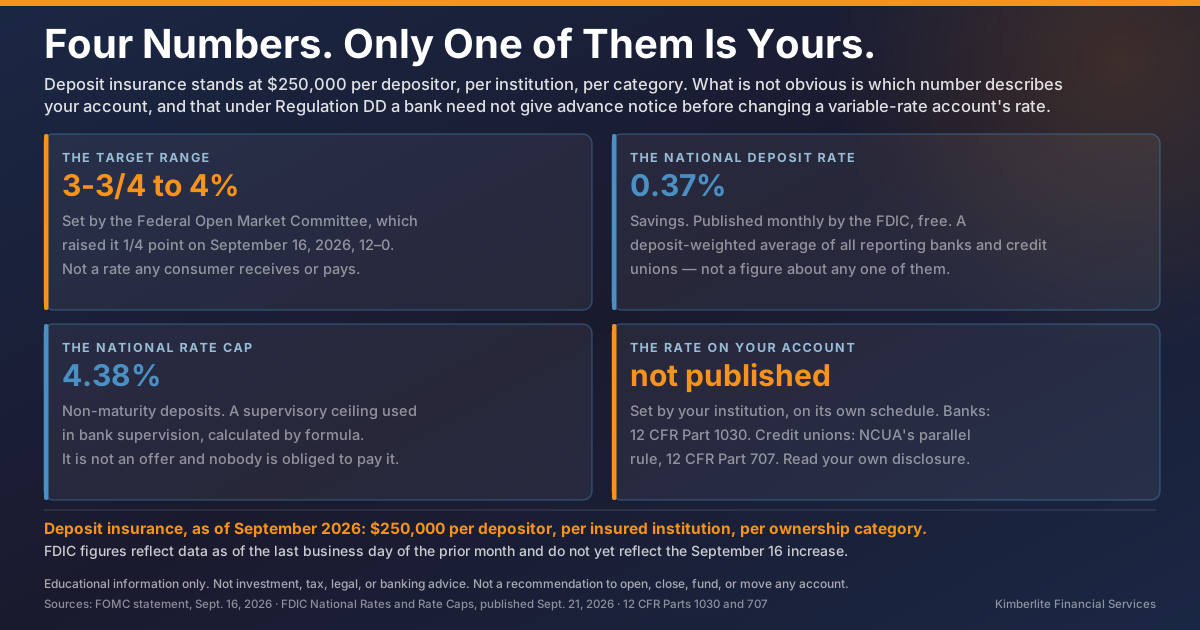
The Federal Open Market Committee raised the target range for the federal funds rate on September 16, 2026. Deposit insurance stands at $250,000 per depositor, per insured institution, per ownership category; the comparison data is published free by a federal agency; and the disclosures that answer several of the questions below are already in a document you own. What is less obvious is that under Regulation DD, a bank need not give advance notice before changing the rate on a variable-rate account — and that Regulation DD does not reach credit unions.
A deposit rate looks like a price. It behaves like a decision. Four different figures circulate in the same conversations about savings rates, and only one of them describes the money in your account. Knowing which number is which is most of the work.
Two things happened in the last two weeks that make this worth a household's attention. This post takes no position on either.
The first is that on September 16, 2026, the Federal Open Market Committee voted 12–0 to raise the target range for the federal funds rate by a quarter point, to 3-3/4 to 4 percent. The approved statement runs three paragraphs. It says economic activity "is expanding at a solid pace," that "[p]roductivity growth is strong, and capital investment is robust," that job gains "have kept pace with the workforce," and that "[i]nflation remains elevated" and "[t]oday's policy action will support a timelier return to the Committee's 2 percent goal." That last phrase is the Committee's own forward-looking statement about its own action; it is quoted here as the Committee's language and is not this firm's view or forecast. The Board of Governors separately raised the interest rate paid on reserve balances to 3.90 percent and the primary credit rate to 4.0 percent, both effective September 17.
The second is that a search-interest vendor reports monthly search volume of roughly 90,500 for the term "hysa" — high-yield savings account. That vendor's finance-category data was last updated September 17, 2026, and reports growth of 95 percent measured over a 24-month window. This post does not claim the September 16 decision caused any of it. The estimate is a proprietary vendor figure cited only to explain why this is the week for this post, and it is not evidence of anything else below.
Put together: the policy rate moved, and the term was already drawing attention. The Committee's decision does not reach your account. Something else has to happen first, and the disclosure rules that govern it are narrower than most people would guess.
Before any of the mechanics, the reassuring part, because most of this post is about paperwork rather than exposure.
Those are the good-news items and they are not small. Deposit insurance is automatic, free to the depositor, and unchanged at $250,000 per depositor, per insured institution, per ownership category. The comparison data is published by a federal agency at no charge. The disclosures that answer several of the questions in this post are already in a document your institution handed you. And more than half of U.S. adults report a three-month cushion — unchanged from 2024, though down from a high of 59 percent in 2021.
One honest caveat on that last card. The Federal Reserve's survey measures what people say about themselves, not observed behavior, and it asks two different questions that are easy to conflate. On the better-known one, 63 percent of adults said they would have covered a hypothetical $400 expense "exclusively using cash, savings, or a credit card paid off at the next statement," which the Fed calls cash or its equivalent. On a separate question, 70 percent said they could pay an expense of at least $500 using only current savings — which the Fed notes as "suggesting that some people choose to pay with other methods, even if they have cash savings available to them." The widely repeated claim that the remainder "can't afford" $400 is not what the source says. The share who said they would be unable to pay the expense by any means was 12 percent, down slightly from 13 percent in 2024.
Here is the part worth internalizing. These four figures get blended together in ordinary conversation. One comes from the FOMC, two from the FDIC — one of those a supervisory ceiling nobody pays — and the fourth from your own institution, which is the only one that describes the money in your account.
This is a target for the rate at which depository institutions lend reserve balances to each other overnight. It is not a rate any consumer receives or pays. The Committee set it by a 12–0 vote on September 16, 2026. The Board's implementation note set the interest rate on reserve balances at 3.90 percent and the primary credit rate at 4.0 percent, both effective September 17.
What it does not do: no rule requires a consumer deposit rate to follow it, and it does not set your rate. The effective federal funds rate — the market rate that trades inside the range the Committee sets, and which the Committee does not set by decree — does feed one regulatory ceiling, described two cards below. Nothing obliges any institution to pay any particular rate on your account.
The FDIC publishes, free, a monthly table of national deposit rates. In the table captioned "Monthly Rate Cap Information as of September 21, 2026," savings is 0.37 percent, interest checking is 0.07 percent, money market is 0.63 percent, and the 12-month CD is 1.73 percent. The FDIC defines the national rate as "the average of rates paid by all insured depository institutions and credit unions for which data is available, with rates weighted by each institution's share of domestic deposits."
Two things to hold onto: the FDIC does not label these figures "APY" anywhere on that page — they are "national deposit rates." And the page states that "[a]ll published rates and yields are based on information available on the last business day of the prior month end," so the September 21 label is a publication date, not an observation date.
Further to the right in the same table sits a much larger number, and it is the one most likely to be misread. The national rate cap is a supervisory ceiling under 12 C.F.R. § 337.7, used to restrict deposit-gathering by insured depository institutions that are less than well capitalized. It is not a market rate, not an average, and not an offer — and it does not apply to credit unions at all, although credit-union rates are among the inputs to the national rate average it is built from. By the FDIC's own formula, the cap for non-maturity deposits "is the higher of the national rate plus 75 basis points or the federal funds rate plus 75 basis points." The table prints five numeric columns, and for savings the row reads: National Deposit Rates 0.37; National Deposit Rates Rate Cap Adjusted 1.12, which is 0.37 plus 0.75; Treasury Yield 3.63; Treasury Yield Rate Cap Adjusted 4.38; and National Rate Cap 4.38. The higher of the two adjusted figures becomes the cap. Note that the column headed "Treasury Yield" does not hold a Treasury yield here: the FDIC's own footnote states that "[f]or non-maturity deposits, where there is no comparable treasury yield, the yield used is the effective federal funds . . . rate published by the Federal Reserve Bank of New York."
The honest version of the point: the cap's formula is built from the effective federal funds rate, which tracks the Committee's target range without being set by it; the national deposit rate has no such formula and is simply what institutions in fact paid. But both figures come from the same monthly publication and both reflect data as of the last business day of the prior month, so neither one yet reflects the September 16 increase. The 3.63 figure is a pre-increase value.
This is the only one of the four that describes your money, and no agency publishes it. It is set by the institution holding the deposit, at whatever interval that institution chooses, subject to the terms of the account agreement you signed and to the notice rules described in the next section.
Where to find it: the current rate is on your statement or in online banking. The rules governing how it may change are in the account disclosure you received at opening, which is a different document.
Truth in Savings — Regulation DD, issued by the Consumer Financial Protection Bureau and codified at 12 C.F.R. Part 1030 — governs what a depository institution must tell a consumer about a deposit account. One scope point first, because it changes which rule applies to you:
Regulation DD's change-in-terms provision reads, in relevant part:
That is the core of the mechanism. Thirty days' notice is the general rule for a change that reduces the yield or adversely affects the consumer — and the first exception carves out the rate itself, for any account that is a variable-rate account.
Which raises the question of what makes an account a variable-rate account. The regulation defines it, and the definition contains its own escape hatch:
Read that clause carefully, because it runs in the depositor's favor. An institution may contract to give 30 days' advance written notice of rate decreases. If it does, the account is not a variable-rate account for this purpose, the § 1030.5(a)(2)(i) exception does not apply to it, and a rate decrease then requires the 30 days' advance notice that § 1030.5(a)(1) would otherwise demand. Whether your institution made that commitment is a question your own account agreement answers.
If the account is a variable-rate account, four disclosures were required at opening. Under § 1030.4(b)(1)(ii), the institution had to disclose: "(A) The fact that the interest rate and annual percentage yield may change; (B) How the interest rate is determined; (C) The frequency with which the interest rate may change; and (D) Any limitation on the amount the interest rate may change." Section 1030.4(b)(1)(i) applies to every account, fixed or variable, and required the institution to disclose the "annual percentage yield" and the "interest rate," using those terms; for a fixed-rate account that same paragraph also required the period of time the interest rate will be in effect. Either way, the answer exists in writing.
The § 1030.4(b)(1) disclosures, the current rate on your statement, and the account agreement's own notice terms. All of it is free, and most of it requires nothing but looking.
A rate change is a change in a § 1030.4(b) term; it is simply excepted from the notice requirement for variable-rate accounts. Section 1030.5(a)(2) contains exactly three exceptions: variable-rate changes, changes in fees assessed for check printing, and changes in any term for time accounts with maturities of one month or less. Changes to most other disclosed terms — minimum balance requirements, balance computation method, fees other than check printing fees — still require the 30-day notice if they may reduce the yield or adversely affect you.
For a time account (a CD) longer than one month that renews automatically, § 1030.5(b) requires pre-maturity disclosures at least 30 calendar days before maturity, or at least 20 days before the end of a grace period of at least five days. Short-term time accounts of one month or less are separately excepted from the change-in-terms notice under § 1030.5(a)(2)(iii).
Nothing in Regulation DD requires an institution to raise a rate, to raise it when the FOMC does, or to raise it by any amount. It is a disclosure rule, not a pricing rule. It also does not displace the account contract, and under § 1030.1(d) it preempts state law only to the extent state requirements are inconsistent with it. This post does not address state banking or deposit law (it does address Utah income tax law, in a separate section below), and it addresses the account contract only to the extent § 1030.2(v) makes the contract decisive.
Because "hysa" is the term that prompted this post, it is worth saying plainly what that phrase is and is not. "High-yield savings account" has no definition in Regulation DD. The phrase does not appear anywhere in Part 1030, including its official interpretations. There is no threshold a rate must clear to earn the label and no agency that certifies it. It is a marketing description attached to an ordinary deposit account, governed by the same rules as any other.
What is regulated is how a rate may be advertised, and Regulation DD is unusually specific. Section 1030.8(b) provides that "[i]f an advertisement states a rate of return, it shall state the rate as an 'annual percentage yield' using that term," that the abbreviation APY may be used provided the full term appears at least once, and that the advertisement "shall not state any other rate, except that the 'interest rate,' using that term, may be stated in conjunction with, but not more conspicuously than, the annual percentage yield to which it relates." The APY is the comparable number precisely because the rule forces everyone to quote the same one.
When an advertisement does state an APY, § 1030.8(c) requires it to state the following as applicable, "clearly and conspicuously":
(1) For a variable-rate account, a statement that the rate may change after the account is opened. (2) The period of time the APY will be offered, or a statement that it is accurate as of a specified date. (3) The minimum balance required to obtain the advertised APY — and for tiered-rate accounts, the minimum for each tier, stated "in close proximity and with equal prominence to the applicable annual percentage yield." (4) The minimum opening deposit, if it is larger than the minimum balance needed to get the rate. (5) A statement that fees could reduce the earnings on the account. (6) For time accounts: the term of the account; a statement that a penalty will or may be imposed for early withdrawal; and, for certain noncompounding time accounts longer than one year meeting the conditions in § 1030.8(c)(6)(iii), a statement that interest cannot remain on deposit and that payout of interest is mandatory.
Item (3) is the one worth looking for. For a tiered-rate account the rule requires the minimum balance for each tier to appear in close proximity and with equal prominence to the applicable APY, so the balance that earns a given rate should be visible right next to it.
Two further provisions cut in the reader's favor. Under § 1030.8(a)(2), an advertisement may not "[r]efer to or describe an account as 'free' or 'no cost' (or contain a similar term) if any maintenance or activity fee may be imposed on the account," and "[t]he word 'profit' shall not be used in referring to interest paid on an account." And under § 1030.8(d), if a bonus is advertised, the advertisement must state the APY, the time requirement to obtain the bonus, the minimum balance required to obtain it, the minimum balance required to open the account if that is higher, and when the bonus will be provided.
There are two gaps, both written into the rule rather than being oversights. Section 1030.8(e)(1) exempts advertisements made through broadcast or electronic media such as television or radio, outdoor media such as billboards, and telephone response machines from paragraphs (c)(1), (c)(2), (c)(4), (c)(5), (c)(6)(ii), (d)(4), and (d)(5) — that is, the variable-rate statement, the time-period-or-accuracy-date item, the minimum opening deposit, the fees statement, the early-withdrawal-penalty statement, and two of the five bonus items. The Bureau's official interpretation to § 1030.8(e)(1)(i) states that the exemption "does not extend to advertisements posted on the Internet or sent by email," so a web page carries the full set. Indoor signs at a depository institution or a deposit broker have a further exemption under § 1030.8(e)(2) — but an exempt indoor sign that states a rate must still state it as an APY and must still advise consumers to contact an employee for further information about applicable fees and terms. § 1030.8(e)(2)(ii).
The second question worth asking about cash is not what it earns but where the insurance attaches. Start with the affirmative, because it is the larger part: pass-through coverage is expressly provided for by rule. Under 12 C.F.R. § 330.7(a), "[f]unds owned by a principal or principals and deposited into one or more deposit accounts in the name of an agent, custodian or nominee, shall be insured to the same extent as if deposited in the name of the principal(s)." FDIC insurance covers $250,000 per depositor, per insured bank, for each account ownership category, and that coverage can reach the underlying owner even where the owner did not open the account.
What follows are the conditions that make it work, and they are recordkeeping conditions. Section 330.5(b)(1) provides that the FDIC "will recognize a claim for insurance coverage based on a fiduciary relationship only if the relationship is expressly disclosed, by way of specific references, in the 'deposit account records' . . . of the insured depository institution." The same paragraph adds that express indication is not necessary where the FDIC determines, in its sole discretion, that the titling of the account and the underlying deposit account records sufficiently indicate a fiduciary relationship — the regulation's own examples are an escrow agent, a title company, or a company whose business is to hold deposits and securities for others. Section 330.5(b)(2) requires that the details of the relationship and the other parties' interests "be ascertainable either from the deposit account records of the insured depository institution or from records maintained, in good faith and in the regular course of business, by the depositor or by some person or entity that has undertaken to maintain such records for the depositor." That details requirement applies even where the paragraph (b)(1) titling exception is used; § 330.5(b)(2) says so expressly. Where there are multiple tiers of intermediaries, § 330.5(b)(3) sets out two permitted methods; under the alternative method, § 330.5(b)(3)(ii)(C) adds that "[n]o person or entity in the chain of parties will be permitted to claim that they are acting in a fiduciary capacity for others unless the possible existence of such a relationship is revealed at some previous level in the chain."
These are recordkeeping requirements. Whether they are satisfied in any particular arrangement is a question for the institution and the intermediary, and this post makes no claim about any of them.
Context only, and the post makes no claim about where any reader's deposits are held. According to the Utah Department of Financial Institutions' Forty-Fifth Annual and Seventy-Ninth Report of the Commissioner of Financial Institutions, as of June 30, 2025 there were 16 industrial banks chartered in Utah holding $221.17 billion in total assets, 51.6 percent of all Utah state-chartered institution assets, up from 15 institutions and $205.66 billion a year earlier. The Department's industrial banks page states that seven states may charter industrial banks — California, Colorado, Hawaii, Indiana, Minnesota, Nevada, and Utah — and that "[c]urrently, five of these seven states have operating industrial banks." The practical relevance is narrow: an industrial bank is a state-chartered, FDIC-insured depository institution, so everything above about deposit insurance applies to it in the ordinary way. No institution is named.
Utah computes state taxable income starting from federal adjusted gross income — § 59-10-103(1)(a)(i)(A) defines adjusted gross income by reference to Internal Revenue Code § 62 — and then applies the additions and subtractions in § 59-10-114. Section 59-10-114(2)(a) subtracts from adjusted gross income the difference between "the interest or a dividend on an obligation or security of the United States or an authority, commission, instrumentality, or possession of the United States," to the extent it is included in federal AGI and "exempt from state income taxes under the laws of the United States," and "any interest on indebtedness incurred or continued to purchase or carry" that obligation.
That subtraction is not a policy choice Utah made. The controlling federal authority is 31 U.S.C. § 3124(a): "Stocks and obligations of the United States Government are exempt from taxation by a State or political subdivision of a State," subject to two exceptions not relevant here. Utah's statute is the mechanism implementing a federal prohibition.
The shape of it, stated without any comparison of yields, because a comparison would require yields this post does not state: interest on a bank deposit is subject to both federal and Utah income tax. Interest on a direct U.S. Treasury obligation is subject to federal income tax and subtracted for Utah purposes. Utah's individual rate for 2026 is 4.45 percent under § 59-10-104(2)(b), effective January 1, 2026. The size of any difference depends on the yields actually available on each instrument at a given moment, which this post does not state and does not compare. Three qualifiers belong with the point: the subtraction is a net figure, reduced by any interest on debt incurred to carry the obligation; the statutory 4.45 percent is not every filer's marginal Utah rate, because the taxpayer tax credit under § 59-10-1018 phases out with income; and a Treasury security is not a deposit — it is not FDIC insured, it has a maturity date, its market price can move if it is sold before maturity, it must be reinvested at an unknown future rate, and its interest remains fully taxable federally.
These are the FDIC's national deposit rates, not annual percentage yields, and not any institution's offered rate. The FDIC's savings and interest-checking rates are based on its $2,500 product tier and its money market and CD rates on an average of its $10,000 and $100,000 product tiers, so none of them is a rate for a $25,000 balance; the $25,000 is stipulated solely for legibility. Not a projection, not a guarantee, and not anyone's actual result. Simple interest is used for legibility; real accounts compound, charge fees, and impose minimums, and this reflects none of that, nor federal tax. The statutory 4.45% is not every filer's marginal Utah rate. This post does not advertise, offer, or solicit any deposit account.
Every figure in that box is arithmetic on published third-party rates applied to a balance this post made up. Its only purpose is to show what the published national averages come to at a legible balance. Kimberlite Financial Services does not offer, sell, or hold deposit accounts, and nothing in this post recommends opening, closing, funding, or moving any account.
Kimberlite Financial Services offers project-based financial planning engagements in three tiers: a targeted, single-topic written plan addressing one defined area, which the brochure lists as including examples such as debt and cash-flow analysis; a comprehensive plan covering goals, cash flow, balance sheet, retirement projections, allocation review, tax considerations, insurance review, and an estate-planning overview; and a complex/business-owner plan that adds business-entity, equity-compensation, or multi-account and multi-entity analysis. Coordination with your CPA or attorney is a deliverable of the Tier 3 ongoing financial planning engagement, which is a separate agreement from a one-time project plan. We are not a bank and do not offer deposit accounts. We do not prepare tax returns, represent taxpayers, or provide tax advice; our planning engagements consider tax consequences, and the Tier 3 ongoing engagement includes coordination with the tax professional you retain. Insurance review is included at the comprehensive and complex project-based tiers, and insurance needs is one of the single topics a targeted Tier 1 plan may address — Ryan J. Hammett is a licensed insurance producer and the sole member of Kimberlite Insurance Services LLC and would receive commissions on any insurance placed through that entity, which is a conflict of interest, and you are never required to buy insurance through KIS. Advisory services are provided for compensation; our services, fees, and conflicts of interest are described in Form ADV Part 2A and Form CRS, available on request and at adviserinfo.sec.gov.
Educational Content Only. This content is provided by Kimberlite Financial Services for educational and informational purposes only. It is not personalized investment, tax, legal, banking, insurance, or accounting advice, and should not be relied upon as such. Nothing in this post is a recommendation to buy, sell, or hold any security, including any United States Treasury security, certificate of deposit, or money market instrument; to open, close, fund, defund, or move any bank, credit union, brokerage, or other account; to select or leave any financial institution; to change how any cash is held; or to take or refrain from any other financial action. General observations about what published federal regulations say, what a federal agency publishes, and what a household might read in its own paperwork are educational points offered to a general audience. They are not tailored to any individual's circumstances. The information reflects publicly available statutes, regulations, agency publications, and government data as of the publication date and may become outdated; deposit rates in particular are variable by nature and every rate figure in this post may be different by the time it is read.
What Kimberlite Financial Services is not. Kimberlite Financial Services is not a bank, a credit union, an industrial bank, a savings institution, a trust company, a broker-dealer, a deposit broker, a money transmitter, a payment app, a fintech platform, a custodian, a certified public accounting firm, a tax return preparer, an enrolled agent, a law firm, or a government agency. It does not accept deposits, hold client cash, offer or sell deposit accounts or certificates of deposit, set or negotiate any deposit rate, provide FDIC or NCUA insurance, determine insurance coverage for any account, maintain deposit account records, prepare tax returns, provide tax advice, or represent anyone before the Internal Revenue Service, the Utah State Tax Commission, the Federal Deposit Insurance Corporation, the National Credit Union Administration, the Utah Department of Financial Institutions, or any other agency. Whether any particular account is insured, in what amount, in which ownership category, and by which institution is a fact-specific determination that depends on the deposit account records of the insured institution and that this post does not and cannot make. Insurance coverage questions should go to the insured institution and to the FDIC or NCUA directly; tax questions should go to a qualified tax professional; and questions about the terms of any account agreement should go to the institution that wrote it.
Authority of the sources described. The United States Code and Utah Code provisions cited here are statutes. Regulation DD, Part 707, and Part 330 are legislative regulations in force. The FDIC's National Rates and Rate Caps table is an agency data publication, not a rule, and the FDIC states the rates are based on information available on the last business day of the prior month end rather than on the publication date. The Unified Agenda is a semiannual statement of agency regulatory intentions; it is not a rule, it binds no one, and an entry in it is not a prediction that the described rule will be adopted, adopted in any particular form, or adopted at any particular time. The Federal Reserve's household survey is a self-reported sample survey of adults. Where an agency publication and the underlying statute or regulation conflict, the statute or regulation governs.
Third-party figures are theirs, and are not comparable to one another. The Federal Reserve policy figures, the FDIC rate table, the FDIC and NCUA insurance provisions, the Utah Department of Financial Institutions charter and asset figures, the Utah Code provisions, the Federal Reserve household survey, and the search interest estimate come from different organizations and cover different subjects, periods, geographies, and methodologies, and are not directly comparable. Each is labeled with its own source and vintage above. The search interest figure is a proprietary vendor estimate that Kimberlite Financial Services has not independently verified and that is cited only to explain topic selection. This post contains no performance results and no hypothetical performance. The following are this firm's own arithmetic, applied to rates published by a federal agency and to a balance this post stipulated: $92.50, $157.50, $432.50, and $19.25 in the illustrative box; the rounding of the Utah Department of Financial Institutions' reported $221,171,251 thousand and $205,658,966 thousand to $221.17 billion and $205.66 billion; and the observations that 0.37 plus 0.75 equals the 1.12 the FDIC prints and that 4.38 less 0.75 equals the 3.63 the FDIC prints. None of those figures is a projection, a guarantee of any rate, any yield, any tax result, or any other outcome, or a performance result of Kimberlite Financial Services or of any account, portfolio, institution, or advisory service. No reader should expect them. Simple interest is used for legibility; actual accounts compound, charge fees, and impose minimums, and the arithmetic reflects none of that, nor federal income tax, nor any filer's actual marginal Utah rate.
Third parties are described, not evaluated. References to federal and state agencies, statutes, regulations, rulemakings, published data tables, and charter categories are factual descriptions drawn from the cited sources. They are not recommendations, endorsements, disparagements, or ratings. No bank, credit union, industrial bank, savings institution, brokerage, payment app, fintech platform, or other private financial institution is named, rated, compared, or evaluated anywhere in this post, and nothing here should be read as a statement about the practices of any particular institution. The Federal Reserve Bank of New York is named once, inside a quoted federal agency footnote, and is not a private institution. The only private companies named anywhere in this post are Semrush and its Exploding Topics product, identified in the sources above, and Kimberlite Insurance Services LLC, an affiliate; none of the three is rated or evaluated. The FDIC national deposit rate is a deposit-weighted national average; a rate above or below it is not evidence of anything about any institution. Kimberlite Financial Services receives no compensation from any organization named in this post.
No predictions. Kimberlite Financial Services does not predict monetary policy, interest rates, deposit rates, inflation, economic growth, securities markets, legislation, regulations, rulemakings, agency guidance, enforcement practices, or the pricing, notice, or business practices of any bank, credit union, custodian, platform, or other institution, and nothing in this post should be read as such a prediction. Nothing here forecasts what the Federal Open Market Committee will do next, whether or when any institution will change any rate, in which direction, by how much, whether any institution will give notice of a change, whether the FDIC will finalize, modify, or abandon the pending rulemaking described above, or what any reader will find if they follow the checklist. Statements about the United States Code, federal regulations, Utah statutes, and agency publications describe their status as of the publication date only and may change. Past rates and past data do not indicate future rates or results.
Political neutrality. This post describes an action of the Federal Open Market Committee, enacted federal and Utah statutes, regulations in force, published agency data, and one pending rulemaking. It takes no position on the merits of any of them, on monetary policy, on inflation or the state of the economy, on any proposal to adopt, amend, or repeal any rule or statute, on bank chartering policy, on the pace of any agency's rulemaking, or on any political party, official, candidate, or campaign. No individual official is named.
Registration and affiliations. Kimberlite Financial Services LLC is an investment adviser registered with the State of Utah. It may transact business only in states where it is registered or is excluded or exempt from registration. Kimberlite Financial Services is not affiliated with the Federal Open Market Committee, the Board of Governors of the Federal Reserve System, the Federal Reserve Bank of New York, the Federal Deposit Insurance Corporation, the National Credit Union Administration, the Consumer Financial Protection Bureau, the Office of the Law Revision Counsel, the Utah State Legislature, the Utah Department of Financial Institutions, the Utah State Tax Commission, the Internal Revenue Service, or any other government agency named above. Semrush and Exploding Topics are unaffiliated commercial vendors. Kimberlite Insurance Services LLC is an affiliate, as described under Conflict of Interest Disclosure below.
Conflict of Interest Disclosure. Two conflicts are relevant to a post on this subject. First, insurance. Ryan J. Hammett is the sole member of Kimberlite Insurance Services LLC, a separate, affiliated insurance agency, and is a licensed insurance producer who may receive commissions on insurance products sold through that entity. This creates a conflict of interest with respect to any discussion of insurance. This post does not discuss, compare, evaluate, or recommend any insurance product, policy type, feature, or carrier. Except where this post refers to Kimberlite Insurance Services LLC, to Mr. Hammett's insurance producer license, to insurance products or insurance advice, or to the insurance review included in a planning engagement, the word "insurance" here means federal deposit and share insurance provided by the FDIC and the NCUA, which is not a commercial insurance product, is not sold by anyone, and generates no compensation for any person. The planning engagement described in the call to action above may address insurance at any tier — insurance needs is one of the listed Tier 1 single-topic areas, and an insurance review is included at the comprehensive and complex tiers. This conflict applies to any engagement that addresses insurance, at any tier, and any insurance product would be placed through Kimberlite Insurance Services LLC on a commission basis. You are never required to purchase insurance through KIS. Second, custody. This post invites readers to find out which insured institution holds cash reached through a platform or brokerage sweep. Kimberlite Financial Services recommends a single qualified custodian for client investment management accounts and receives custodial platform technology, portfolio management, billing, reporting, training, and practice-support services from that custodian at no direct cost. That is a conflict of interest, described in Item 14.A.1 of Form ADV Part 2A. Any cash held in a client account at that custodian is subject to the custodian's own arrangements, which this post does not describe, evaluate, or recommend.
Before making any financial, tax, or legal decision, consult a qualified professional who can evaluate your specific situation. Kimberlite Financial Services makes no representations or warranties regarding the completeness or accuracy of the information presented.